
Highly Sensitive - How This Affects OCD Treatment - Carrie Bock

135. Highly Sensitive? How This Affects OCD Treatment

Inspired by a suggestion from our listener Ashley, today Carrie is diving into how being a Highly Sensitive Person (HSP) affects OCD treatment. She explores why sensitivity matters and how it can shape your therapeutic journey.

Episode Highlights: 

  • What it means to be a Highly Sensitive Person and how it impacts daily life.
  • How being an HSP can influence the approach to treating OCD.
  • Carrie shares her own experiences with sensitivity and how she manages it.
  • Adjustments therapists can make to accommodate highly sensitive individuals in OCD treatment.

Episode Summary:

In this listener-suggested episode, we explore the intersection of being a Highly Sensitive Person (HSP) and dealing with OCD. Ashley, a listener, reached out to share how understanding her HSP traits has aided her personal OCD treatment, and she wondered how this could factor into an effective therapeutic approach. I wholeheartedly agree that this should be considered, and in this episode, I explain why.

We first dive into what it means to be a Highly Sensitive Person, a trait characterized by heightened awareness and processing of environmental stimuli. I discuss my personal experiences as an HSP, from sensory overload in certain environments to needing silence after social interactions, and how this sensitivity can be both a challenge and a superpower.

The episode also covers the importance of tailoring OCD treatment for those who are highly sensitive. While Exposure and Response Prevention (ERP) is the gold standard for OCD, it’s crucial to approach treatment with empathy and understanding, especially for clients who might feel overwhelmed by traditional methods. I emphasize the need for open communication with your therapist to ensure the treatment process is effective and manageable.

Finally, I talk about anxiety sensitivity and how therapists can help clients become more comfortable with the physical sensations of anxiety. My hope is that this episode helps you, whether you’re highly sensitive or not, understand that there’s a reason God made you this way—and that it can be your superpower, not your burden.

Today we have a listener-suggestion podcast episode. Just super fun. Ashley had reached out to me via email and she told me that she, for her own personal benefit and treatment, has found the research on the highly sensitive person to be super helpful helping her understand herself. She’s found that not every therapist has been open to hearing about that. And she wondered, how does being a highly sensitive person factor in to a treatment approach for OCD? In short, I agree with what Ashley is saying. It should matter. And coming up, we’ll see why…

Hello and welcome to Christian Faith and OCD with Carrie Bock. I’m a Christ follower, wife and mother, licensed professional counselor who helps Christians struggling with OCD get to a deeper level of healing. When I couldn’t find resources for my clients with OCD, God called me to bring this podcast to you with practical tools for developing greater peace.

We’re here to bust through the shame and stigma surrounding struggling with OCD as a Christian, sharing hopeful stories of healing and helping you replace uncertainty with faith. I’m here to help you let go of the past and future to walk in the present abundant life God has for you. So let’s dive right in to today’s episode.

I wanted to let you all know that this is your absolutely last chance to sign up for the Freedom from Mental Compulsions Challenge, happening on August the 5th at noon central time. So go to hopeforanxietyandocd.com/challenge We’re going to be talking about ICBT and how this can help with mental compulsions.

I am giving away a few prizes, coffee gift cards, and coaching time with Carrie, so we can’t wait to see you there. We’re in the midst of shifting websites, so I’m not sure which one we’re going to be on by the time this episode comes out. Hopefully long term we will be on carriebock.com. We’ll have all of my counseling and podcasting info housed in the same spot, which will be really helpful.

Before we talk about how being a highly sensitive person can impact OCD treatment, let’s first talk about what does that mean, something you maybe never heard that term before. There is a test, a self-test for you at hsperson.com. This is Elaine Aron’s website, and she’s the one who has done a research on being a highly sensitive person, back since 1991, she’s written several books, The Highly Sensitive Person being her signature most popular book, and then she’s written materials about having a highly sensitive child, which would be very interesting to read as well.

Some of the questions from the self test, “Are you easily overwhelmed by such things as bright lights, strong smells, coarse fabrics, or sirens nearby? Do you make a point of avoiding violent movies and TV shows? Do you need to withdraw during busy days into bed or a darkened room or some other place where you can have privacy and relief from a situation?” Do you make it a high priority to arrange your life to avoid upsetting or overwhelming situations? Those are just a few sample questions. There are several more on the website for you to look at, but the main thing to understand is that highly sensitive people are really taking in all of this environmental stimuli that’s around them, and they’re getting a read on the situation, taking in information before acting or responding a little bit slower to process information because they’re getting so much in because they’re just sensitive to everything that’s going on. The lights, the sounds, the people, the emotions of the people, just all of these different things are factored in.

One in five people, so about 20%, are highly sensitive. It’s not the same thing as introversion, although the majority of them are introverts. About 70 percent of HSPs, that’s a shortened for a highly sensitive person, are introverts. It may be confused with shyness at times. It’s not the same thing as being shy, but a lot of times, especially if it happens in children, and this happened with me, they’ll say, “Oh, she’s shy.” It’s never a good connotation when somebody says that, so please don’t do that to your children, and I will not do that to mine. At least in my case, it was never said positively. It was always a negative. This is not a medical or psychological diagnosis like OCD. It’s more of an understanding of your own temperament and how you process sensory information.

I want to share with you how being a highly sensitive person has impacted my life a little bit and steps that I take to mitigate it. There’s a certain big box store, which shall not be named, but you can probably figure out which one it is when I describe it, that I prefer not to go in. I have gone in there plenty of times and bought things, but it’s not my preference because you go in there and not only is it all the fluorescent lighting, which they’ve made quote sensory-friendly hours now where you can go early in the morning and the lights are more dim, and I’m sure that does help people, but it’s not just the lighting for me.

It’s the massive quantities of stuff that’s in this store. There’s aisles and aisles of stuff. You have to go in there and find what you need, which is not always easy, unless you know where the stuff is in the store. There’s lots of stuff, and then there’s even stuff in the middle of the aisles, where you’re trying to go through. Then on the end of the aisles, like the end caps, if you’ve ever worked in retail, you know exactly what I’m talking about. There’s stuff even hanging from the end caps. There’s just stuff everywhere. And it’s a lot to take in, and it’s a lot to go, “Oh, there’s all this stuff, but where’s my stuff that I need? How can I get in here and get my stuff and not 80 other things?” Because that’s the whole strategy, right? That’s the whole strategy of having stuff everywhere, is they want you to look at it and buy it. It’s too much for me. Most days I just don’t want to do it. That’s one situation where being highly sensitive has affected me.

Daylight bulbs are really huge in our household. We have moved, and there isjust been so many little things that you want to shift and to move or change out. And one of those for us has been daylight bulbs. We got into our house, and we’re like, Ugh, it’s all this, like, orangey, fluorescent lighting.

Can’t take it. Went to the store, bought some daylight bulbs, and honestly, we’re still switching some of them out. We have some recessed lighting that we’re not happy with, and I’m not even sure we have to figure out how to change some of those pieces out, but Steve and I are both on board with the daylight bulbs.

We just do not like, in our home, in our peaceful space, we do not like the other type of lighting that there is out there. Another way being a highly sensitive person, one thing I’ve learned to mitigate with that is I can’t always be around constant noise. Some people just have, they have the radio on all the time or the TV on all the time, or they’re constantly getting something into them.

And I do listen to a lot of podcasts as my jam or whatever helps me relax or wind down or different things sometimes depending on the type of podcast to listen to. But if I have a really busy day or a day where I’m around a lot of people, this is a big one. If I am around a lot of people, I just have a need for silence.

I don’t want anybody to talk to me and I have to talk with people in my life. It’s, it’s no offense right now if I’m really quiet. I just had a really busy day. I just want to bitch. You can hang with me, but please don’t try to have a conversation with me right now because it’s just not gonna go well. I can get really irritable if I’m around people all day and I don’t have that time for silence or time to decompress for myself.

I think some of that is an introversion thing, but some of it is also a highly sensitive thing. If I go to a concert, and this can happen in movie theaters, not quite as much, not quite the same. If I was to see maybe a really intensely emotional movie in a movie theater, it might affect me a certain way, but as far as for concerts, So in Nashville, we have the Bridgestone Arena.

That’s where the hockey team plays. That’s where they have a lot of like big concert gatherings, things of that nature. There are smaller venues, obviously, in other places. But to go into the Bridgestone Arena, obviously, it’s huge. There’s going to be a ton of people there. But then as well, there’s also going to be a lot of noise.

It’s going to be super, super loud. I am going to want earplugs that I may or may not have forgotten. Lots of lights. So between the lights, the sounds, the people, when I leave that situation, it could be a concert that I really wanted to go to and I really love. Doesn’t matter. But if I leave that situation, the only way I can describe it to you is that I feel like my body is on vibrate.

And it takes me a long time to wind down from something like that. I just feel like I’m still in the concert when I’m not in the concert. Like my body is still trying to process that experience. The concerts can be a challenge for me. I talked about this in our episode on introversion, but one of my highly sensitive things, this one has to do with decision-making and contemplation.

If I’m going to a new restaurant, I will always look at the menu before I go. My husband and other people don’t get this. They probably think it’s really silly. But it’s funny because I remember my dad saying that when he first used to take my mom out to dinner that she would have a hard time choosing like something to eat and so maybe I just come by this completely honest, but I definitely want to see the menu because I want to look at all the options and really contemplate, “What do I actually want to eat?” This is better now because we have online menus and ordering and things like that, but heaven forbid they change the menu from what’s actually online and then I get there and I’m like, oh no, like the thing I wanted, it will be like, oh yeah, we don’t have that anymore or we’re out of that ingredient, so we can’t make that for you.

It’s, Oh no, back to square one, but thanks to the internet. It’s really easy, typically, to look at the menu before you go to the restaurant, and that’s a step that helps me out so much. I don’t know if that helps you out either, if you have a hard time deciding on what you want to eat. I don’t think it’s just a decision-making process.

I think it is the fact that a lot of times, especially go out to dinner with other people, you’re trying to look at the menu, and they’re trying to talk to you, and you’re trying to not be rude. They’ve decided what they want, you haven’t. It’s a whole thing. So I just prevent all of that the best I can. A big part of being highly sensitive is being super in tune to other people’s emotions and not just like picking up on other people’s emotions, but really feeling that and when you’re a kid and you don’t understand that you’re highly sensitive and you just feel everything really deeply, this feels like an absolute curse.

It does not feel like a good thing. You’re crying and somebody else isn’t, or you’re trying to hold something in maybe to not have a huge emotional reaction that you know is not going to go well. Being intuitive, picking up on the emotions of other people or feeling things very differently. As a kid, I never understood, or as a teenager, or even young adult, I didn’t understand probably until I was in my mid 20s how this was actually a positive thing for me and that this could be my superpower as a therapist.

It was hard to mitigate how do I separate my emotions of what I’m actually experiencing from other people’s emotions. and had to learn to be supportive of other people’s emotions without taking them on. And I wish I could tell you a cut-and-dry process to that, but I think it just happened over time.

I had to be comfortable with my emotional experience. I had to be comfortable with other people having their emotional experience. And then I could set up some healthy, just internal boundaries of allowing other people to have their emotional experience without taking it on, without creating responsibility for it.

Obviously, that’s a big thing. As a therapist, you’re there to come alongside somebody and support them through their process, not to just take bad feelings away or fix them somehow. And I will say that it can be challenging because society doesn’t always value being an HSP, especially if you’re a male.

That can be particularly tough. And I know that I’ve had males in therapy that are like, this is not a good thing. I have heard a statistic, although it’s been a while, that even though 20 percent of the population is HSP, about 75 percent of the individuals in therapy are HSPs. Which is why it’s really important for therapists to be understanding, even if they’re not a highly sensitive person, to be understanding how those traits are affecting a lot of their clients.

I love this quote from the highly sensitive person that sensitivity is anything but a flaw. Many HSPs are often unusually creative and productive workers, attentive and thoughtful partners, and intellectually gifted individuals, which is so beautiful. This can manifest beautifully in your life, whether that’s through creative outlets, whether that’s through being really attentive to your work, being able to connect.

That’s what I always tell people. If you are tuned into what somebody else is feeling, a lot of times it can help you connect with them in a really healthy way. Highly sensitive people are going to pick up on things maybe that other people don’t in the room. So in group work, this is helpful to say, hey, have you thought about how that wording comes across? Or because it seems rough to me, have you thought about, what about this person, can we include them? I know for myself if I walk into a social situation, and it’s been like this for a long time, probably because I was this person, but I can walk into a social situation and find that person sitting in the corner by themselves, not talking to anybody.

I can sense and read who in the room is anxious or edgy, and that is a gift in terms of ministry, in terms of being able to reach people. Now how does this affect OCD treatment? I couldn’t find a statistic on how many people diagnosed with OCD would also be considered highly sensitive, but I did find this comment in response to an article that someone had written about their experience, and I think it sums it up pretty well.

On the one hand, your mind is constantly processing everything around you in high detail, which can be exhausting. That’s the highly sensitive piece. On the other hand, your OCD tendencies can make you feel like you have to control everything around you, which can be totally exhausting. It’s a constant balancing act that can be difficult to manage.

Wow. That’s pretty intense there. How does this inform OCD treatment? OCD treatment tends to be pretty structured. There may be a therapist, let’s say they’re trying to follow ERP correctly, we would call that fidelity to the model. We’re trying to have fidelity to the model which has been researched and will, if we follow it the way that it’s written and supposed to be done, then our clients theoretically will get better.

That’s the goal and the idea. And so they may prompt a client to do an exposure that the sensitive person might feel is overwhelming or too much. They might need something broken down into smaller steps. So exposures are designed to be very gradual in nature. It’s important if you’re doing this type of therapy to make sure that you feel comfortable enough with your therapist to communicate when things feel overwhelming.

They’re not trying to give you a panic attack. That is not the point. Because you want to move through these hierarchies in a way that’s building confidence in tackling harder and harder things. But sometimes with ERP, there can be this mentality that’s a little bit like, hey, you’ve got to toughen up, pull yourself up by your bootstraps, just push through.

That can be damaging. I won’t say that with all therapists, but Just sometimes with that model, it can be like, Hey, this is hard, but you still got to do it. Especially working with very avoidant people. Obviously, you have to push people a little bit more and that makes sense. So finding that balance with the client and the therapist can be really hard because you don’t want to just be like, okay, whatever you want to do. After all, then that person is not going to get better.

So finding that middle ground. And I know I’ve had clients in the past drop out of EMDR therapy for similar reasons. Like, maybe they got overwhelmed, they didn’t feel comfortable enough to let me know they wanted to stop, or maybe they had residual effects after the fact, which can certainly happen. If things are really rough for you after your last session, if you feel like things are just not working or not going the way that you need or want them to, Your therapist needs to know that.

Like, we really appreciate the feedback because that helps us tailor things specifically to you. We’ve been trained in all of these therapy modalities, but the idea is really to tailor them in such a way that’s going to help you get better as that can be a challenge, right? Because people are so different.

So what may work for one person might not work for somebody else, and that’s okay. If you’re a highly sensitive person, just finding somebody that you feel comfortable with, that you feel that sense of empathy. Oh, they get it. They see where I’m coming from. Another thing that we can do in the beginning stages of OCD treatment is work on things like anxiety sensitivity.

Anxiety sensitivity is when you’re sensitive or afraid of the physiological sensations, the body sensations that accompany anxiety, like rapid heart rate, difficulty breathing, or dizziness. In session, your therapist may have you induce some of these distress states outside of a period of panic or high anxiety to help you get used to the body sensations and know that they’re not actually going to harm you. It’s not necessarily the body sensations themselves, it’s the feeling out of control of the body sensations when they come on sporadically. A lot of times it’s troubling for people. Ways to work on this, your therapist may have you turn in circles for dizziness, like run in place, or do jumping jacks to increase your heart rate, breathing through a coffee stir for dizziness.

These types of activities can be helpful because sometimes clients get triggered even during workouts, even though it’s normal during a workout to have some difficulty breathing or to have an elevated heart rate. You can learn, okay, I can be in this state, my body is not being damaged by it, it’s a normal reaction.

With OCD treatment, we’re working on retraining your threat detection system. So if you can feel those feelings in your body in a safe environment, like therapy, that would be the ideal. You can know and learn to tolerate them as uncomfortable as they may be. My hope is that this episode may help some of you understand yourself a little bit better and just know if God has created you as a highly sensitive person, there’s a reason that you are this way, and I pray that he shows you how that can be a superpower instead of a burden, because I know for me, for a long time, I just saw it as a burden.

And now I can see it as a superpower and I can do things in my life to take care of myself so that I am not overwhelmed all the time by sensory information. Until next time, may you be comforted by God’s great love for you.

Were you blessed by today’s episode? If so, I’d really appreciate it if you leave us a review on iTunes account or Apple Podcasts app on your computer if you’re an Android person and leave us a review. This really helps other Christians who are struggling with OCD be able to find our show. Christian Faith in OCD is a production of By the Well Counseling. This podcast is for informational purposes only, and should not be a substitute for seeking mental health treatment in your area.

Three Strategies to Help Stop Obsessive Praying Today - Carrie Bock

134. Three Strategies to Help Stop Obsessive Praying Today

Carrie explores how OCD can interfere with your prayer life and offers effective strategies to manage it. She addresses the challenge of repetitive praying and offers practical advice for dealing with OCD’s demands.

Learn how to stay connected with God and maintain a meaningful spiritual practice despite these challenges.

Episode Highlights:

  • How OCD can mess with your prayer life and what to do about it.
  • How to use scripture in your prayers for more focus and clarity.
  • Why it’s crucial to resist the urge to repeat prayers due to OCD’s demands
  • Strategies to overcome obsessive praying.

Episode Summary:

In this episode of Christian Faith and OCD, I share three strategies to help stop obsessive praying, a common struggle for many dealing with OCD. If you find yourself repeating prayers because they don’t feel sincere enough or confessing the same sins repeatedly throughout the day, this episode is for you.

First, I encourage you to try something new in your prayer life. It’s easy to fall into a rut, especially when OCD dictates that there’s only one “right” way to pray. I recommend exploring different prayer methods, like centering prayer or breath prayers, to break free from obsessive patterns. Remember, prayer is about connecting with God and aligning your will with His, not about achieving perfection.

Second, I suggest having a dedicated time for confession. By setting aside intentional moments once or twice a day for confession, you can avoid the cycle of confessing sins repeatedly throughout the day. Trust the Holy Spirit to guide you in this process.

Finally, I talk about resisting the urge to repeat prayers. OCD often convinces us that our prayers weren’t good enough the first time, leading us to repeat them. But God hears us the first time, even when our prayers aren’t perfect. It’s important to remember that OCD-driven anxiety and guilt are false alarms, and you don’t need to give in to them.

I also touch on the benefits of ICBT (Inference-based Cognitive Behavioral Therapy) in managing mental compulsions, which we’ll explore more in our upcoming Freedom from Mental Compulsions Challenge. If OCD is impacting your prayer life, consider joining us for the challenge to learn practical tools for breaking free from these patterns.

Thank you for tuning in, and if you found this episode helpful, please consider leaving a review on iTunes or Apple Podcasts. Your support helps other Christians struggling with OCD discover the show. Until next time, may you be comforted by God’s great love for you.

Explore Related Episodes:

Hello and welcome to Christian Faith and OCD with Carrie Bock. I’m a Christ follower. wife and mother, licensed professional counselor who helps Christians struggling with OCD get to a deeper level of healing. When I couldn’t find resources for my clients with OCD, God called me to bring this podcast to you with practical tools for developing greater peace.

We’re here to bust through the shame and stigma surrounding struggling with OCD as a Christian, sharing hopeful stories of healing and helping you replace uncertainty with faith. I’m here to help you let go of the past and future to walk in the present abundant life God has for you. So let’s dive right into today’s episode.

I know some of you have been hearing about this for the last few weeks, but you are down to the wire on the last few days to sign up for the Freedom from Mental Compulsions Challenge. You can sign up at hopeforanxietyandocd. com/challenge. We are going to do some fun giveaways. We’ll give you some coffee gift cards. There’s going to be free coaching with Carrie given away. I’m so excited to be talking with you about ICBT and how that can really help. The way I explained this to someone the other day is if you’re dealing with a physical compulsion, like I’ve got to go check that doorknob lock, from me to my doorknob or my door lock, that might be five to ten seconds, depending on where I am, and I might have some time to think about not going back and checking that, but if you’re struggling with mental compulsions, your brain is always right there, and it’s an easy, quick go to.

ICBT will literally help you train your brain to think differently and to recognize these obsessions as an invalid argument. At the time of this recording, we’ve already got several people signed up, so please come join them: hopeforanxietyandocd.com /challenge.

Today I want to talk with you about three strategies to help stop obsessive praying. Some of you are going through and repeating prayers over and over again because the first time you pray it, something just doesn’t quite feel right, or maybe you’re repeating the prayer because you didn’t feel like you were sincere the first time. Maybe you’re finding that you’re confessing over and over again throughout the day.

We’re going to talk about each one of those things today. The first strategy I have for you is to try something new in your prayer life. This is just good advice for all of us as Christians. Get into a rut of speaking with God the same way all the time. And it’s not bad to follow certain prescriptive prayer methods.

I don’t know if you’ve heard of Acts, which is adoration, confession, thanksgiving, supplication, kind of helping you process instead of just going to God and asking for something, using some of these others, making sure that you’re praising him and thanking him, confessing your sins, all of that. Those types of strategies are good.

If we’re going get out of a rut in our prayer life, be willing to try something new, and this is going to be uncomfortable especially if OCD is telling you, you have to pray this certain way, or no, you didn’t do it right, or it wasn’t good enough or sincere enough. I want to refer you to a couple of previous episodes that we’ve had on prayer. In episode 48, I talked with Rich Lewis on this practice of centering prayer, just really more of a meditative type of prayer, where you’re sitting in silence, you’re focusing in your mind just more on an image, maybe of Jesus, or the focus is more on spending time in God’s presence, allowing God to utilize that time to fill you and bring you at peace in his presence. This is very different than many of us pray. So, I encourage you that if you’ve never done that before, maybe try that. Maybe try sitting in silence and listening. Maybe just taking some time to slow down. There are many different ways to pray, so don’t allow OCD to get you stuck or pigeonholed into just one way of praying.

In episode 75, we talked with Jennifer Tucker about breath prayers. This is where you have certain words that you would say like on the inhale, and they’re based on scripture. For example, you could inhale, “The Lord is my shepherd, and exhale, I shall not want, or you could exhale. I have all that I need.” You can inhale, “The Lord is my refuge and strength.” Exhale, “an ever-present help in times of trouble.” With anything, this in itself could become compulsive as well. You just have to play around with some different things. If you are really sitting and trying this out, I know some people have obsessions about breathing, so that may throw you off. It’s just an opportunity or an invitation to calm your mind and your body while you’re breathing and also speaking out scriptures. Jennifer talked about how breath prayers really helped her get through a difficult time where a lot was happening with her daughter and she just didn’t have a lot of words at that point.

When you’re so overwhelmed or stressed, sometimes, less is more, and really focusing on what is the purpose of our prayer. The purpose of our prayer is to connect with God and to align our will with His. We’re not trying to make something dramatic happen. We’re not trying to change God’s mind or bend His hand.

We are just saying, “Okay, I am here.” I am intentionally focusing myself on connecting with the presence of God because God is the source of everything. That’s it. God has everything that I could ever need in this life, physically, emotionally, spiritually. I want to be abiding in the vine and receiving that nourishment.

That’s what our prayer time is about. It’s about connecting with God and surrendering. It’s not about me. It’s not about what I want today. It’s not about here’s my list of 50 things I want to happen. Yes, it’s totally fine to ask God for things. He wants us to come to him with our needs, with our joys, with our sorrows, with everything, but prayer is about at the end, God’s will be done. “These are the things that I’m laying before you, God, but ultimately I want you and I want your will and your desires to be above my desires.” As you pray and you align yourself with the will of God, then God gives you a heart for certain things that maybe you didn’t have a heart for before. All of a sudden, you start feeling passionate about certain areas or like, “Okay, I feel like God is leading me in this direction.” Maybe you feel like, “Oh, God is asking me to give something up so that I can focus on something else that’s more important. God’s giving me comfort that whatever situation is going to work out.” We can approach it different ways. It may be that you approach it as kind of like a checklist item. “Okay, this is one more thing. I know I really need to pray. It’s a spiritual discipline. I need to do it.”

Maybe you’re in a Christian tradition where you repeat certain prayers. I know in the Orthodox tradition, they have certain morning prayers or evening prayers. I know that in the Catholic tradition, they say certain prayers, and if that’s a part of your particular tradition, you still want those prayers to have meaning and significance and connect you back to God.

Another strategy you can try to shake up your prayer life a little bit if you’ve never done this before, is to pick specific scripture verses to pray. They may be scriptures from the Psalms, or they may be scriptures from the New Testament. So, for example, in James 1, 2, it says, “Consider it a great joy, my brothers and sisters, whenever you experience various trials, because you know that the testing of your faith produces endurance, and let endurance have its full effect, so that you may be mature, incomplete, lacking, and nothing. “That’s actually James 1, You could even turn this into a prayer regarding your OCD, so you could say, “Dear God, please give me joy in this trial of OCD. Develop my endurance so that I may be more mature, complete, and lacking in nothing.” Proverbs 3, 5, and 6 say, “Trust in the Lord with all your heart and do not rely on your own understanding.”

In all your ways know him and he will make your path straight. This is a familiar scripture. So if we were to pray that scripture, we would say something similar to, God, I want to trust you. I want to really trust you with all of my heart. Help me to know when I am relying on my own understanding instead of trusting you.

Allow me to know you at a deeper level so that I can follow your path. I know when I do that, that you promise to make my path straight. So there we have a New Testament and Old Testament example of praying the scriptures. Let’s face it, there are going to be times where you’re in a low point, you may feel really overwhelmed, you’re lost, and you just don’t even know what to pray or maybe your mind just feels so full, you may feel down, depressed, lonely, whatever it is. I can think of a couple of different times in my life where that definitely fit my circumstances. One was when I went through my divorce in 2015. That was a really low, depressing point for me. And another one was when I lost my parents, but I remember reading this, another verse in James.

One, where it talks about, the scripture basically says that every good and perfect gift comes from God. So when I realized that, it caused me to shift into this attitude of gratefulness and I just started thanking God for everything that I did have in my life because the loss felt so big. and so overwhelming that at the time was overshadowing the good things that were in my life.

So I intentionally focused my prayer life on gratefulness. Let me just make a very specific list of everything to God that I’m grateful for. I was driving in my car going down the road just saying, okay, God, thank you for this car. It’s old, but it runs well. It gives me where I need to go. I’m able to go to work and back.

I’m able to go to the store and get food. Yes, I’m so thankful I have food on my table. I’m thankful that I have a place to live where I feel safe and comfortable. Just things that we take for granted that not everybody has. If you start thanking God and being in a place of gratitude, that will absolutely shift your mood.

I don’t know how it could not. Gratitude is so good for your mind and emotions and obviously your spirit. Maybe you take some time in your prayer life to really sit and praise God for his character. Praising Him for His holiness, His righteousness, His faithfulness, enduring love, God is incredibly patient.

These are just a few of God’s attributes, but when you start to go through those and praising God, and thinking about his true character, that shifts our mindset to realize how big and how vast and how incredible God is. And if you realize, like, how big and vast and incredible God is, yet at the same time, So profound he wants to have a relationship with us.

This is absolutely mind-blowing when we break it down I know these are things we hear in church, but we don’t really sit and marinate them The God of the universe is holy set apart yet loves you and wants a relationship with you incredible When we realize how big God is, we realize how small our problems really are.

There is no problem that God can’t solve. God is in the business of doing God-sized things. that humans cannot explain or take credit for. I don’t know if you’ve ever been in that situation in your life where you’re like, okay, how am I going to make it through this month? How am I going to pay this medical bill? How am I going to get to work? I got laid off. How am I going to get a job? And then somehow God just shows up because he’s that good. I did not mean to get into all this today, but somebody needed to hear that.

We’re talking about three strategies to help stop obsessive praying. So our first one, we only got through number one. Try something new. Two is have a dedicated time of the day for confession. This is a ditch that you really might be falling into because I see it time and time again. You’re going through your day, you feel really bad about something, you confess it, but then you’re starting to question, Did I sin? Did I not sin? What happened? And then you’re confessing again. Confessing for stuff you’ve already confessed that happened five years ago. It can really cause that obsessive cycle loop to be going on. Let’s not do that. Be intentional one to two times a day, okay? Maybe in the morning, maybe at night, if you’re not fully awake in the morning, do it at lunch, but a couple of times a day where you sit down and you say, okay, Lord, let me think through and be intentional about the things that I’m confessing. And here’s the deal, if you can’t remember it, or the Holy Spirit doesn’t prompt you to remember it, to confess it, wasn’t a sin, we’re not worrying about it, moving on.

We have to trust the conviction of the Holy Spirit as Christians. The Holy Spirit is not going to let you go way off track. The problem is if we start to ignore him. Most of you who are listening to this episode and are trying to be conscientious about confessing, I don’t imagine that you are stiff-arming the Holy Spirit.

I’ve had clients who have practiced this dedicated confession time and they have told me that it really cuts down on getting stuck in that confessional loop spiral where you’re feeling questioning sin and feeling like you’re having to confess all day long. And the third strategy is I know it’s going to be hard for some of you.

Resist that urge to repeat that prayer because here’s the story that OCD is going to spin you. It’s going to tell you that your prayer wasn’t sincere enough. Were you even thinking about what you were saying? You need to go back and do that again. Just to make sure. And then OCD might start attacking your character and your relationship with God and all this other extra.

You have to remember that OCD brings up these real intense feelings of anxiety that are going to lead you to believe, or it could be a feeling of guilt, or may just feel like something just doesn’t feel quite right. And in those moments, you can’t trust those feelings because they are a false alarm of your threat detection system.

So when OCD is encouraging you to repeat that prayer, you don’t need to. God heard it the first time. My daughter is only two years old, so she doesn’t have a full vocabulary, but she’s starting to speak more and more in sentences, which is really cool because When she was younger, you just had to guess at what she wanted or what she needed.

It’s kind of hit or miss, but the cool thing is I do want her to talk to me. I don’t always understand what she says. She blurs things together because she’s still learning. But I want to hear from her. I want her to speak to me. God wants to hear from his children, too. And quite frankly, we don’t always get it right.

Sometimes we ask for some dumb stuff. My daughter might ask me for cookies right before dinner. I’m gonna be like, no, you can’t have that. I look back at things that I thought I wanted. I’m glad God didn’t answer those prayers, okay? But he heard everyone and he cared about me enough as a good father to give me what I needed, not always what I wanted.

So if you’re having perfectionism issues with your prayer life, Know that it doesn’t have to be perfect. God wants to hear from you. Communicate with him. If you find OCD is really messing with your prayer life, please join us at the Freedom from Mental Compulsions Challenge. You only have a few more days to sign up.

It is on August the 5th at noon Central Time. We’re going to be talking about how ICBT can help with mental compulsions. I’m going to be teaching through the 12 modules of ICBT very soon and would love to see you there. I want to share with you one of our iTunes reviews. This is by Marnie. I cannot thank you enough for this podcast and how much it is truly helping me.

I’ve been listening to as many episodes as possible since I found it last week. I’m beginning a new counseling journey where I now feel so much hope to be vulnerable and heal from shame due to lifelong anxiety and OCD. I feel a sense of relief and grace, encouraged and so hopeful. I truly cannot tell you enough what listening to these episodes has done for me already.

I will be forever grateful. Thank you so much for sharing that with us, Marnie. I received two emails this week from individuals in Canada as well. So hello to our Canadian listeners. We’re so glad that you’re here. And until we get our new website built, don’t get me started. Breathe. Patience. We are still at hopeforanxietyandocd.com. Until next time, may you be comforted by God’s great love for you.

Were you blessed by today’s episode? If so, I’d really appreciate it if you would go over to your iTunes account or Apple Podcasts App on your computer if you’re an Android person and leave us a review. This really helps other Christians who are struggling with OCD be able to find our show.

Christian Faith in OCD is a production of By the Well Counseling. This podcast is for informational purposes only, and should not be a substitute for seeking mental health treatment in your area.

Looking for an Alternative to ERP - Find out if ICBT is Right for You - Carrie Bock

133. Looking for an Alternative to ERP? Find out if ICBT is Right for You

Carrie discusses Inference-Based Cognitive Behavioral Therapy (ICBT) as a helpful option, explaining how it differs from ERP in addressing OCD symptoms and integrating faith perspectives. 

Join her as she explores ways to find peace and faith while managing OCD through these therapeutic approaches.

Episode Highlights:

  • The principles of ICBT and its approach to mental compulsions.
  • The importance of respecting someone’s faith in OCD treatment.
  • Common misconceptions about OCD treatment options and their effectiveness.
  • Practical tips for considering ICBT over traditional ERP methods.

Episode Summary:

In this episode of Christian Faith and OCD, I discuss an alternative to Exposure and Response Prevention (ERP) called Inference-based Cognitive Behavioral Therapy (ICBT). While ERP is the gold standard for treating OCD, it’s not always the right fit for everyone. Some find ERP too overwhelming or not trauma-informed, especially those dealing with co-occurring conditions like PTSD. ICBT offers a different approach, focusing on challenging the obsessional doubt at its core rather than just managing the anxiety it produces.

ICBT helps you recognize that OCD weaves facts with imagination, creating a story that feels all too real. By identifying the crossover point where you shift from the present moment into this imagined scenario, you can begin to break free from the cycle of obsessions and compulsions. What I love most about ICBT is its focus on the “feared self” versus the “real self.” The feared self is who OCD tries to convince you that you are or will become, but it’s a false identity. ICBT helps you reconnect with who God says you are—loved, valued, and free.

If you’re wondering which therapy is right for you, it’s essential to choose the path that aligns with your needs and challenges. Both ERP and ICBT require dedication and hard work, but the reward is a life of greater freedom and peace. Remember, you are stronger than you know, and you can overcome the struggles of OCD with the right support.

Thank you for joining me today. If you found this episode helpful, I’d appreciate it if you could leave a review on iTunes or Apple Podcasts. Your feedback helps others find our show and begin their healing journey. Until next time, may you be comforted by God’s great love for you.

Explore related episodes:

Hello and welcome to Christian Faith and OCD with Carrie Bock. I’m a Christ follower, wife and mother licensed professional counselor who helps Christians struggling with OCD get to a deeper level of healing. When I couldn’t find resources for my clients with OCD, God called me to bring this podcast to you. With practical tools for developing greater peace. We’re here to bust through the shame and stigma surrounding struggling with OCD as a Christian, sharing hopeful stories of healing and helping you replace uncertainty with faith. I’m here to help you let go of the past and future to walk in the present abundant life God has for you.

Let’s dive right into today’s episode. If you haven’t heard, we are running a freedom from mental compulsions challenge on August the 5th at noon central time. You can sign up at www.hopeforanxietyandocd. com/challenge and we’re going to be giving away some cool stuff like free coaching with Keri, and maybe some coffee gift cards thrown in there.

You’re not going to want to miss it, so I will see you there. Welcome to episode 133. Have you been looking for an alternative to exposure and response prevention, ERP? I know that this is an important thing that many individuals with OCD are looking for. Maybe you’ve had a bad experience with ERP. Maybe it just feels too big or too overwhelming or too scary to do.

Maybe you’ve heard stories from other people and don’t feel as comfortable with the therapy. Well, today we’re going to talk a little bit about exposure and response prevention and then talk about ICBT as a potential alternative. I don’t want you to get stuck on black-or-white thinking, like one of these therapies is right, one is wrong, one is better, one is not better. Both of these therapies have been researched and are evidence-based treatments for obsessive-compulsive disorder. Both therapies have helped people heal, so we’re not in the interest of putting one above the other. We’re just letting you know that there are options out there that some people in the OCD community don’t know about.

What is exposure response prevention? This is a behaviorally based therapy. that focuses on developing a treatment hierarchy, things that you are avoiding due to OCD, things that you fear engaging with, and then you develop exposures, gradually exposing yourself to the things that are scaring you in order to overall reduce the anxiety, decrease the compulsions because you’re engaging in the activity.

You’re feeling the anxiety and you’re not engaging in the compulsion. It’s a way to retrain your brain so that when you encounter those things in the future, the triggers, you know, okay, this is OCD. I’m fully aware of what it is. It’s very uncomfortable, but I can sit with this and not engage in the compulsive activity.

Exposure and response prevention is referred to by the International OCD Foundation, among others, as the gold standard for OCD treatment. We’ve talked more in depth about ERP on the show. You can go back and listen to episode number 74. with Stacey Quick and episode 111 with Judy Lair, who both talk more in depth about what exposure and response prevention is and how it can be helpful for OCD. Both of these individuals work for NoCD, which is a online therapy group, and NoCD specifically hires therapists and focuses on using strict ERP as their main focus of treatment. Like any large online therapy practice, it really depends on the therapist that you get connected with and whether or not you have a good connection or relationship as far as what your success may or may not be.

If you’re going to be doing hard things, obviously feeling comfortable with the person you are doing those hard things with is really important. This is true for any type of therapy, not just ERP. I have a much older episode about ERP not being the only treatment for OCD where I talk about utilizing EMDR to really get down to the core fear and the inadequacies that people feel about themselves to create a sense of healing and that as we treat the trauma and those core fears that a lot of times the OCD symptoms would go down. I definitely need to update that episode now that I am engaged with doing more inference-based cognitive behavioral therapy, or ICBT, as we’re going to call that. This episode has been pretty popular. People have searched and found it on Google because they’re looking for alternatives to ERP. If this is the gold standard, then we have to ask ourselves, why are people looking for alternatives?

There’s several different reasons for that. ERP is effective, but it’s not perfect. I’m a therapist. I can tell you that no therapy is perfect. EMDR is not perfect. ERP is not perfect. ICBT is not perfect. This is why therapists often use multiple modalities of therapies with their clients in order to help them find the greatest level of healing. That would make you a somewhat eclectic therapist if you’re using multiple therapy modalities. When you get too stuck on one and try to pigeonhole everyone into the same type of therapy, I’ve probably done it myself, admittedly, then you run into all sorts of problems because people are complex beings and they come in with complex presentations.

One quarter of individuals who meet criteria for an OCD diagnosis also meet criteria for a PTSD diagnosis. There are times where ERP is not always trauma informed. It may exacerbate PTSD symptoms. I’ve had this happen with clients who saw a prior therapist to myself, and they were really just kind of encouraged by the ERP therapist of like, hey, well, this is a treatment for OCD.

We’ve got to keep doing this. We’ve got to keep going down this road, and unfortunately, they may have failed to look at the entire clinical presentation of that individual. Another reason people are looking for alternatives to ERP is that it’s hard. The reality of sitting with all of these uncomfortable anxieties, emotions, fear, body sensations that come up connected with that, it’s hard, and a lot of people end up dropping out of the process.

Just as ERP is at times not trauma-informed, it can be depending on the therapist. At times, it’s not religiously sensitive. I’ve also seen cases of this and that’s highly unfortunate because the International OCD Foundation has a great page on their website about religiously sensitive exposures.

They’re also very open and focused on working with clergy of a variety of different faith communities to help people who are dealing with scrupulosity or religious obsessions be able to get the best care and treatment possible. Let’s say that you’re doing ERP and maybe you cannot find a Christian therapist in your area who does that.

You may want to ask if that therapist would be willing to connect with your pastor to help you create appropriately religiously sensitive exposures so that you’re not feeling like you’re going against your faith by engaging in treatment. That is not what any ERP therapist would want you to do.

Another potential issue with ERP is that it can be harder to target mental compulsions. This is where I feel like ICBT has an edge over ERP. If you are targeting mental, like, worst-case scenarios, a lot of that’s imaginal exposure, where you’re having to write imaginal scripts and read those over and over.

A lot of times you’re writing down things that are not true about yourself, things that are not true about God. Some Christians struggle sitting with those things, to be quite honest, and I would be as well if I was the one having to engage in that type of therapy. The goal of that imaginal script is to retrain your brain to recognize that it doesn’t have to have a hold on you, and it doesn’t have to continue to create anxiety. You are sitting with the anxiety and essentially making it boring. I find that sometimes people end up playing whack-a-mole with their symptoms, doing a lot of different exposures over a variety of different themes, but they’re not really getting at the core fear. This is something that I feel ICBT does a little bit better job of.

Before I really knew about ICBT, like I said, I was using a lot of EMDR to really help people drill down what is it that you are really, really afraid of. Not just, I’m afraid of getting sick or I’m afraid of getting somebody else sick if I touch this doorknob. But. Like this deeper level of that, that deeper layer might be something like, I’m going to get so sick that I won’t be able to take care of my children and my family and other people will suffer.

At its core, exposure and response prevention is focused On feeling the anxiety, not engaging in the compulsion. So they’re focused on that piece of the equation. ICBT is different. It focuses on recognizing that the obsession is really irrelevant to the present moment right now. So if you resolve the obsessional doubt than you resolve the need to engage in the compulsion.

There are 12 modules to ICBT, so obviously it would take a long time to go through each of those modules. That’s another plug to join us in the workshop on August 5th where we’ll be able to talk about this more in depth. ICBT is based on the idea of inferential confusion. People with OCD overestimate possibility. They make irrelevant associations. They disregard sensory information, not just your five senses, but also your sense of self, who you are as a person. ICBT requires you to really slow down and focus on your thought process in a different way. It’s validating to a lot of my clients because it lets them know the obsession isn’t just coming out of nowhere.

There are reasons that you’re thinking these things that you’re thinking. It’s based on information that you know to be true that’s just a plain fact. Like germs are real. As a Christian, we have certain facts that we believe about forgiveness, repentance, salvation. Obsessional doubt may come from your own personal experience as well as hearing about the experiences of others, whether that’s people you know or whether it’s just another YouTube video you watched or something you read on Reddit.

What ICBT does is it helps you recognize that OCD is taking those facts and weaving them in with imagination to create a story. And this is not just any story, it is like a lifetime movie based on a true story that really sucks you in. and causes you to feel intense emotions, intense level of fear, even though nothing bad is happening right now.

ICBT helps you identify that when you get triggered, there is this crossover point from the present moment experience over into the imagination. And learning that crossover point helps you not to continue on with the obsessional story. But here’s my favorite part about ICBT. It causes you to look at identifying the feared self versus the real self.

The feared self is who you believe that OCD is telling you either that you are right now or that you’re going to become if you don’t engage in these compulsions. For example, someone may believe that if they don’t read their Bible enough, that means they are not a good Christian. Of course, reading your Bible enough is very relative.

I only read one chapter today, does that mean that I don’t really love God or don’t really care about Him? This belief system about self Whether it’s that I’m unworthy, not enough, that I’m going to harm other people, that somehow I have these, like, deep-seated desires to do things that are inappropriate.

That is a feared self, and it’s a false self. It’s not who you really are. Who you really are is who God says that you are. You are loved. You are valued. God wants you to have abundant life. God wants you to have joy. God wants you to have joy, even in the midst of difficult circumstances. You are a child of God. You are forgiven. You are free.

There are so many different things that I could say here about who you are in Christ. I encourage you to search the scriptures for those yourself. So let’s talk for a moment about, well, which therapy is best for me? How do I know? Here’s what I know. OCD recovery is no joke, okay? It’s hard either way. So whether you do ERP or whether you do ICBT, it’s going to be difficult. It’s going to require time. It’s going to require dedication. So choose your hard. You know what’s even harder? Living with unmanaged OCD symptoms that sucks the joy out of your life when God is calling you toward an abundant life with Him where there is joy and peace and freedom on the other side. I want you to know that whatever you choose to do to engage in, in your recovery of OCD, that you are strong. Stronger than you know. You can do hard things and I pray that you find the help that you need and the support that you need to be able to walk through these challenging times as you’re struggling as you know,

We’re in the process of of rebranding a bit and getting our website fixed. So until then, we are still at hopeforanxietyandocd.com or you can find me at my counseling practice, bythewellcounseling.com. Thanks so much for listening. Until next time, may you be comforted by God’s great love for you.

Were you blessed by today’s episode? If so, I’d really appreciate it if you would go over to your iTunes account or Apple Podcasts app on your computer if you’re an Android person and leave us a review. This really helps other Christians who are struggling with OCD be able to find our show. Christian Faith and OCD is a production of By The Well Counseling. This podcast is for informational purposes only and should not be a substitute for seeking mental health treatment in your area.
Sexual Obsession or Lust Scrupulosity Wants to Know with Steve and Carrie

132. Sexual Obsession or Lust? Scrupulosity Wants to Know with Steve and Carrie

In this week’s episode, Carrie brings back her favorite co-host, her husband Steve to discuss the difference between sexual obsession and lust in the context of scrupulosity, offering practical, faith-based strategies for managing these thoughts.

  • The distinction between sexual obsession and lust within the context of OCD and scrupulosity.
  • The different ways men and women process visual stimuli and attraction.
  • Practical strategies for men to avoid falling into patterns of lust.
  • The importance of recognizing and addressing unrealistic expectations regarding sin and temptation in the journey of sanctification.
  • How to differentiate between genuine conviction from the Holy Spirit and compulsive confession driven by OCD.

Explore Related Episode:

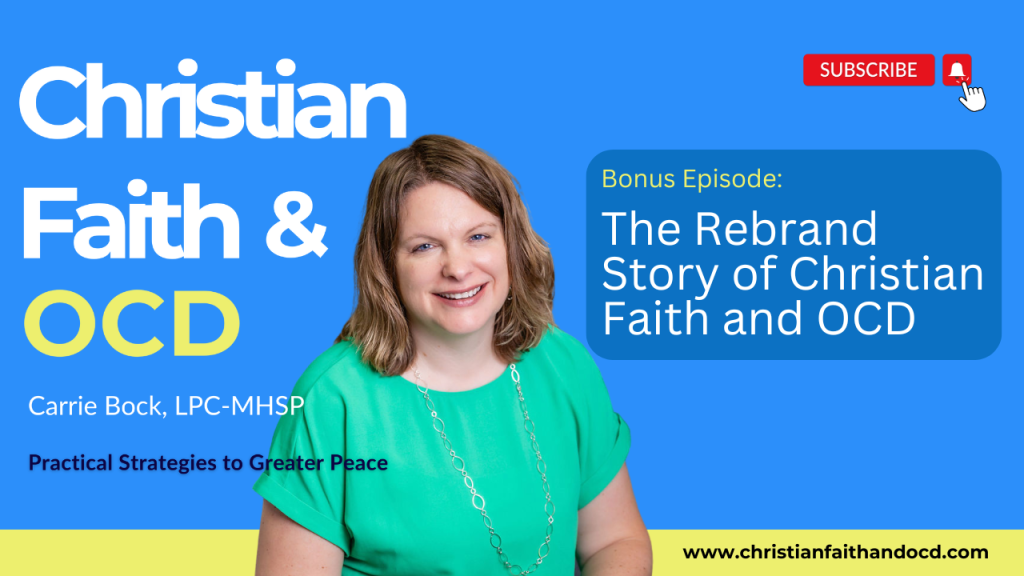
The Rebrand Story of Christian Faith and OCD - Carrie Bock

Bonus Episode: The Rebrand Story of Christian Faith and OCD

Join Carrie as she introduces the rebranded podcast, “Christian Faith and OCD. She shares the journey from “Hope for Anxiety and OCD” to the new focus, discussing the reasons behind the change, listener feedback, and the impact the podcast has had over the past three and a half years.

Episode Highlights:

  • The strategic decision to focus more on OCD and include “Christian” in the podcast title.
  • The significance of addressing scrupulosity and faith-informed therapy for OCD.
  • How Carrie found guidance through prayer and a Christian podcast coach.
  • Plans for the podcast, including practical resources for managing OCD
  • Upcoming webinar: The Freedom from Mental Compulsions Challenge

Episode Summary:

Welcome to a special bonus episode of Christian Faith and OCD! Today marks the beginning of our rebranding journey from Hope for Anxiety and OCD to Christian Faith and OCD. I’ve been hosting this podcast since the fall of 2020, and over the past three and a half years, we’ve seen incredible growth and transformation. However, earlier this year, I noticed a decline in our download numbers, which led me to reevaluate the podcast’s direction and purpose.

After much prayer and reflection, I realized it was time for a change. This rebrand focuses more intentionally on OCD, especially since our most popular episodes have consistently been those centered on OCD topics and personal stories. By adding “Christian” to the title, I’m ensuring that our content is clearly faith-based, which is crucial for listeners seeking spiritual guidance alongside mental health support.

Through this process, God has shown me the importance of sharing my knowledge and experiences directly with you, our listeners. While I love interviewing guests, I’m shifting towards more solo episodes to provide practical strategies for managing OCD from a Christian perspective. This rebrand also aligns with my passion for helping those with scrupulosity and other OCD-related challenges find peace and healing.

If you’ve been with us from the beginning, thank you for your continued support. And if you’re new, welcome! I’m excited to walk alongside you on this journey of faith and mental wellness. Don’t forget to join us for the Freedom from Mental Compulsions Challenge on August 5th, where we’ll dive deeper into how Inference-based Cognitive Behavioral Therapy (ICBT) can help you manage OCD.

Thank you for being part of this journey. Until next time, may you be comforted by God’s great love for you.

Welcome to Christian Faith and OCD with Carrie Bock, a licensed professional counselor in Tennessee. Some of you are wondering, did I hear that right? Yes, you did. Today is the day we are starting the process of going from Hope for Anxiety and OCD to Christian Faith and OCD. I’ve been alluding to rebranding for quite some time, and I wanted to tell you the story of how this process came about.

I have been hosting Hope for Anxiety and OCD since the fall of 2020. It’s been about three and a half years now. So many good things have happened. I’ve had Christians write to me expressing thanks that they were no longer afraid or ashamed to take medication, which is incredible. Several people wrote saying, Hey, I thought I had anxiety, but I listened to your show.

I started listening to the personal stories of OCD and realized, Hey, I think that’s me. I have OCD. Of course that was life-changing for them to have that knowledge. I’ve been able to meet people, and see people for counseling that might not have found me otherwise across Tennessee had it not been for the podcast.

I’ve even had people travel from out of state to do counseling retreats with me, which I talked about in a previous episode. That’s been amazing. But earlier this year, I noticed that our downloads were declining and I thought, okay, we’re really only producing an episode every other week. I realize that’s a slow pace.

I did that because of having my daughter being pregnant, and going through the process of having an infant. If you’ve been there, you know it’s a lot, okay? I took a little bit of a step back for the last couple of years while my daughter was growing up and recognized, like, this is a good time to go ahead and start putting out an episode every week.

So we started doing that a few months ago. What I didn’t know about the download decline was that it wasn’t just about people getting lost or dwindling away from listening to the show. It had to do with an Apple update where if you were subscribed to podcasts in Apple’s they would download for you.

People’s phones were filling up, they didn’t like that feature and Apple decided to Scrap that with an iOS 17 update, things are no longer auto download. What that means in the podcasting world is that we had a lot of false downloads. We were looking at statistics where maybe a bunch of episodes were downloaded, but people weren’t really listening or people weren’t really necessarily following.

Now all of our download numbers are more accurate picture of who’s actually Initiating that download and listening to the show as I was going through this process Recognizing like okay things had been going up and up and up for a while And then things had kind of leveled off and they were going down I prayed this prayer of desperation of God in late February saying I don’t know what I’m doing I’ve had this podcast for a long time over three years and I just need help.

I need to know Okay, God, what is my next step? What am I really doing here? And it was one of those pivotal moments where you’re like, okay, I’ve got to either keep doing this or I’ve got to stop. Like, it just felt like almost like there was no other option. Like, are we going to keep going? Can I still do this?

And I said, okay, God, if you want me to do this, you are going to have to send me some help to know how to make this podcast better and to grow this show. And. I was in the process and my husband and I were thinking about getting ready to move. I was listening to this organizational podcast. It was just organizing your house, different areas of your house.

I thought, well, this will be really great for me. As I’m decluttering, I’m getting ready to move. I’m thinking about how I’m going to want my house to be more organized when we move. That was a big push for me. Listen to this podcast, and she says something about her friend who’s a Christian podcast coach, and I was like, what, wait?

It was one of those moments where you said, did she just say that? Like, rewound for a few seconds, and I was like, “Oh, okay.” I wrote down the lady’s name, and God’s timing was so specific, she was just getting ready to launch her coaching program again, uh, for a six-month coaching program. I looked it all up online, and I said, okay, God, this is kind of expensive, but if you want me to do this, then you’re gonna have to provide the money because right now it’s not in the account.

Lo and behold, I received some money that I was not expecting. I brought the money into the business. I was able to buy the program and started really making some changes and revamping in that process. I talked to Steve about it. I said, what should I do? Is this okay to spend this money on this? What do you think?

He’s always been just incredibly supportive. Like I said, go for it. I think that this is what you need to do. God lined all of these different things up for you after you reached this breaking point and prayed about it. So here we are, and I started to look at the podcast with completely new eyes.

What were the episodes that you guys were listening to what was getting downloaded the most it just came down to the OCD episodes was a short answer, especially any personal stories related to OCD are probably our most popular episodes other than obviously a lot of people listen to the first episode to see Hey, what’s this whole podcast thing about?

Putting Christian in the title was very strategic because when you have a podcast called Hope for Anxiety and OCD, unfortunately, you get a lot of people contacting you, not realizing it’s a Christian podcast, maybe tuning in, not realizing, hey, we do talk about God and spiritual issues on the show. Unfortunately, we get a lot of what I call woo-woo requests, people that are like metaphysics crystals and some other stuff that I’m like, I don’t think so.

That’s not really what we do over here. Putting Christian in the title was very strategic for me. Focusing more on OCD was obviously very strategic, just in looking at the resources that you guys are looking for. I never would have started an OCD podcast three and a half years ago for a few different reasons.

One, there’s a little bit of an imposter syndrome being in this space speaking to these issues and not having lived experience with OCD. I would say the majority of people that I meet who treat OCD also have OCD. I know that that’s not always the case, but typically in cases of things like addictions.

Eating disorders, OCD, like very specialized areas. A lot of times people have some type of lived experience, either they’ve lived it or someone in their family has lived it. So for me, there is a little bit of an imposter syndrome saying I’m out here treating OCD and I haven’t had that specific experience.

I think that there are pieces of it that feel very relatable to me. The anxiety feels relatable because I’ve definitely had my fair share of anxiety in my life. The catastrophic thinking feels relatable. Perfectionism I can definitely relate to. I am a recovering perfectionist. I don’t consider myself a perfectionist now.

That’s something that the Lord has really worked with me on. It took a period of many years and lots of mistakes and lots of learning to be comfortable with not always doing things right, but praise the Lord I’m not there where I was before. So there are different pieces that I can consider that I can relate to, but I don’t have the lived experience that a lot of you guys have.

It was interesting because I talked with one of our recent guests that I did a personal story with about this, Crystal Probst, and she said it’s okay because one of her therapists that had a lived experience with OCD, she felt like understood her less than the therapist she saw that didn’t have the lived experience, and that was partially due to maybe different themes and different understandings that she felt like that person had.

The other reason I wouldn’t have started a podcast having to do with OCD three years ago is because I didn’t have a large client basis at the time that I started the podcast of OCD clients. Now that has shifted a lot since starting the podcast. I’ve been able to work with more clients with OCD, more clients that had a higher level of severity, and I realized that there’s a lot more help out there in general for Christians with anxiety than with OCD.

In the process of seeing more and more clients with OCD. It’s caused me to dig in a lot deeper, and gain even more knowledge, more training, more consultation with other counselors. I’m constantly learning new things and I’m constantly being challenged, but I enjoy that a lot. I think this intersection of Christian faith and OCD is so important because many people with scrupulosity feel like they’re dealing with a spiritual issue when actually what they’re dealing with is OCD.

So if they feel like they’re dealing with a spiritual issue, they don’t want to take that to someone who is not well versed in Christianity or doesn’t know the Bible. I also know there are significant struggles for Christians who are looking at exposure and response prevention therapy. Sometimes this therapy is not faith informed.

Some people do a really great job of being faith-informed and really knowing how to do sensitive exposures based on a person’s faith. There are therapists that aren’t Christian who are willing to work with your pastor or talk about it. What are the teachings or any of these exposures going against your belief system or would be inappropriate or disrespectful?

However, there are some other people out there that are potentially going kind of rogue. I hate to say negative things about therapists, but it’s just like any other field, there are some good ones and there are some not so good ones. Unfortunately, it’s hard sometimes for Christians to find helpful, appropriate OCD therapy where they feel like this person that they’re receiving help from has a strong spiritual background as well as a strong clinical background.

I know that it can be challenging for clients in ERP to write imaginal exposures. writing things that are not true about God and having to read those over or sit with them. I had a secular provider tell me that she’s recommended clients not pray for a time period. Someone else told me recently that they had heard about exposure of reading the satanic bible, which I don’t see as a religiously sensitive exposure.

These different types of things are coming up and I don’t say that to scare anybody away from ERP. There are some Qualified, healthy ERP trained therapists, we’ve had them on the show before, we’ve also had people on the show with personal stories who’ve received ERP and have had good experience.

Unfortunately, it’s just a mixed bag out there, and some ERP therapists are not trauma-informed. That’s unfortunate, since trauma exacerbates OCD symptoms, and 25 percent of people who are diagnosed with OCD also qualify for post traumatic stress disorder, or PTSD. That’s a good chunk. That’s a quarter of people diagnosed with OCD.

So that’s, trauma is something that has to be taken into consideration. This is one of the reasons that I have really latched on to ICBT therapy, inference-based cognitive behavioral therapy. For me, having a background in treating trauma, this is a much more trauma sensitive and trauma informed therapy treatment for OCD.

One thing that’s shifted with the show, if you’ve noticed and been listening over the last few months, is that this started out being primarily an interview show, and I do love interviewing people, I am gonna have more guests on, but I am transitioning this to a majority solo episode show with some guests sprinkled in who’ve had lived experience with OCD, Thank you Or professional tidbits to share with you guys.

Through this process of reworking the podcast, God has shown me that he wants to me to share with you the knowledge that I’ve learned and to use my voice to speak into the issues that you are all facing. I hear different things all the time, whether it’s from clients that I have, or people writing to me, or people that I’m participating in learning sessions with, and there’s so much that I want to share with you. And I want this show to be more practical tips for a lot of times. We’ve had a variety of different information. It’s a little bit been all over the place. Some people I’m sure have enjoyed that. So our tagline is practical strategies to greater peace. Because I want you to walk away with practical tools and guidance that you can get to have a healthier relationship with your OCD.

Ultimately, I would love for everyone listening to this to be healed, but I also know that just like some people have chronic health conditions, some people have chronic mental health conditions. That doesn’t make you less of a Christian, it is not your fault if you are struggling with OCD, but if we can’t get rid of something, sometimes we can have a different relationship with it.

I’ve seen this in my own life in terms of dealing with some back pain that I’ve had to deal with off and on for the last several years, uh, tailbone pain, and I have seen this in the life of my husband who has SCA, which is a neurological disorder. He’s an incredible testimony that God can still use you, even with your limitations.

He’s actually in Guatemala as this episode is coming out, um, and he’s ministering to children and teens there. I’m definitely so proud of him for that. Now I want to speak with some of you who are struggling with this change. Maybe you’re dealing with anxiety and you’re disappointed that I am focusing in on OCD.

I see you. I also know that some of this information, not all of it, but some of it is still going to apply to you. There are some of you with anxiety that are still googling too much. There are some of you with anxiety that are still dealing with whether you should take medication or not. There are some of you with anxiety that are catastrophizing and coming up with all kinds of worst-case scenarios.

While we might address that a little bit differently in terms of treating anxiety versus treating OCD, some of the information is still going to be relevant to you, and if you want to hang around and listen to it, you’re certainly still welcome to. I see this. podcast as a ministry and God has definitely blessed me by allowing me to be a part of what is now a worldwide ministry.

I would have never imagined that I would be the host of something that’s going out into all of the world. I did not see that coming at all, but I feel so thankful to each one of you who listen. I know that we have a cohort of people who Download our episodes week after week after week. So thankful for all of you.

Even if you just pop in and listen a little bit here and there, I am thankful for you. And know that if you do reach out and send emails and talk to us or communicate with us, I do read all of our emails. I look forward to what God is going to do in the future in and through this podcast platform.

Please join me on August the 5th for a free webinar, The Freedom from Mental Compulsions Challenge, where I’ll be talking with you more about how ICPT can be helpful specifically for mental compulsions, although certainly it works for physical compulsions as well. I’m going to be giving away some free coaching sessions, so I’m excited to be doing that.

The goal is for us to have fun and learn together. To sign up for the webinar, go to hopeforanxietyandocd.com slash challenge. That is one thing I forgot to tell you. Our updated website is in process. Right now, we are working on getting everything switched over to carriebhock.com. That’s a funny story within itself, because I always thought that people who had their own domain name thought a little too highly of themselves and probably swore I’d never do it.

But, it just makes most sense for people who are looking for me, for counseling services, or for the podcast. So, It’s not live yet, but you will know when it’s live if you sign up for our webinar or you get on our email list. Hopeforanxietyandocd. com slash and challenge. See you there. Hope for Anxiety and OCD is a production of By the Well Counseling.

Relationship Obsessions Combined with Scrupulosity Pierre's Story - Carrie Bock

131. Relationship Obsessions Combined with Scrupulosity: Pierre’s Story

In this episode, Carrie shares Pierre’s courageous journey with OCD, exploring how childhood fears and religious teachings shaped his mental health struggles and eventual path to healing through counseling and faith.

Episode Highlights:

  • Pierre’s journey through OCD and the compulsion to replay past events.
  • The role of forgiveness in freeing Pierre from resentment and anger.
  • Pierre’s discovery of peace through trusting in God’s promises during anxious moments.
  • The power of grace in liberating from perfectionism and fear.
  • Insights into how faith and forgiveness can lead to personal and spiritual growth.

Episode Summary:

In this episode of Christian Faith and OCD, I’m honored to share the powerful testimony of Pierre, who has experienced both relationship obsessions and scrupulosity. Pierre’s journey began in childhood, with an early fear of sin and losing his salvation, which later developed into intense OCD symptoms. His story is one of struggle but also of profound spiritual growth and healing.

Pierre discusses how his fears initially took root when a family friend read a Bible passage about the sin against the Holy Spirit. As a child, this deeply impacted him, leading to a persistent fear of blasphemy and the loss of his salvation. These fears followed him into adulthood, manifesting as relationship obsessions and religious scrupulosity, including a deep anxiety about remarriage after his first marriage ended in divorce.

Throughout the episode, Pierre shares how his OCD journey intertwined with his faith, leading to a complex struggle between spiritual concerns and mental health challenges. His turning point came when he began to understand that his obsessions were not sins but rather a mental health issue. With the support of counseling, his wife, and a discipleship program, Pierre learned to renew his mind and reject the lies that OCD fed him.

Pierre’s story highlights the importance of understanding OCD from both a spiritual and mental health perspective. It’s a reminder that God’s love is constant, even in the midst of our deepest fears. If you’re struggling with similar issues, know that you’re not alone and that healing is possible.

Thank you for listening to this episode. If you found Pierre’s story encouraging, please consider leaving a review on iTunes or Apple Podcasts. Your feedback helps others find this show and begin their journey toward peace and healing. Until next time, may you be comforted by God’s great love for you.

Explore Related Episode:

Welcome to Hope for Anxiety and OCD episode 131. I am your host, Carrie Bock, a licensed professional counselor in Tennessee. On today’s show, we have a personal story of OCD from someone named Pierre. We’re not saying his full name on the podcast or sharing any images of him. For ministry reasons, I wanted to bring you this powerful testimony.

Pierre emailed me a while back about his story, and I thought, this is just It’s so powerful. People need to hear what God has done in his life.

Carrie: Pierre, tell me a little bit about your childhood experience and how OCD showed up for you. What did that look like? How did it all start?

Pierre: I don’t know where to start. I wasn’t a fearful child. I wasn’t really somebody who hid in the bed. I was a bit adventurous and I loved the outdoors and I wanted to play every kind of game, but where is when it started really as a child, we had a nanny, a family friend who just came when my parents were out and she would babysit. My brother and I, for bedtime, she would read the Bible to us, and I didn’t even know that it was not the same to do to read the adult Bible to kids.

She would read out of the page, and one night she just read along, and it came to the story of the sin against the Holy Spirit, which at the time, maybe I was eight or nine, I didn’t understand what was it about I just realized that something was off with those stories. Something I didn’t understand. 

I remember when the next day I left by my schoolmates going to school before me. A few seconds in the corridor before the teacher realized, and she grabbed me. I gave my life to Jesus just in case because having heard a story like this, that you can be in danger of hell, even as a child.

Carrie: So you were scared of God after hearing that story?

Pierre: I didn’t understand. What it was about, I just know it was bad. If I found myself in that situation, it was bad. So I wanted to be safe. I had the sense that I could potentially sleep or fall or lose my salvation or something like that, even at that age. I think that was something I carried with me. I had no idea that I could go to my parents and talk about it.

Carrie: Why was that? Were you afraid you’d get in trouble or you weren’t sure that they would understand what you were afraid of?

Pierre: They would not understand. They would not realize it was serious for me. And I had no idea that it would be just a thing to do. When you’re scared, you go to your parents because they’re important people in your life.

They would reassure you. They would explain things. That’s what I do with my own children now. Anything that scares them, I want to talk it over and make sure we’re on the same page. We understand exactly what’s going on and I don’t let it happen again.

Carrie: But there was some teaching in your church that you had told me, like, about emotions and therapy. So maybe there wasn’t this freedom to be anxious or be depressed or have other certain emotions.

Pierre: I grew up in a Christian family, so that’s absolutely fantastic. I even had the privilege of having my parents, my dad is a pastor, and his dad before him was a pastor, so that’s very good. And the flip side is also, I think, the sense that I had very young that I had to be very careful about my behavior in church and elsewhere.

I wasn’t really allowed to be rough and to keep the honor of the family. I would say, something like that. I was very serious about things I heard in church. That was always my belief that He’s a God and we need to be careful not to offend Him. So we don’t sin, we don’t do bad stuff, we don’t use bad language.

Things I discovered later on in life that I never knew, but that’s things you don’t do either. I would say my church has a Pentecostal background. I grew up in the older generation. When I was a kid, these people were still around. I understand now that they came out of the Great Depression and the Second World War period of time, when maybe there was an upbringing of not showing up emotions.

The phrase I heard a lot was put up a smile on your face. Whenever there is some problem in your life, you don’t talk about it, at least openly. You don’t share your struggles.

Carrie: So that makes sense, probably why you wouldn’t share things with your parents if you felt like it.

Pierre: Yes. I can’t really translate that in English, but something I heard is that a sad Christian is a liability to the church. You’re not sad. If you’re a Christian, you have to be joyful. You have to be crazy about God and everything goes well for you. Because the faithful are blessed or something like that.

Carrie: I think a lot of people still believe that today. Like if I’m a Christian, I’m supposed to have joy, I’m not supposed to be angry, that’s another one.

I’m not supposed to be mad, and I’m not supposed to be sad, just supposed to be happy, joy, joy, joy all the time, and that’s just not reality. Thankfully, we have a lot of Christians in the Bible who weren’t happy all the time and who did cry and who did express emotions and thinking, just thinking about David and the Psalms.

I don’t know how people justify those types of beliefs with scripture. When you shifted some of your beliefs on this later in life, I imagine, was that comforting to you to find those places in scripture where Elijah was depressed and David was really sad? I mean, was that kind of comforting like, Oh, you can be sad and be a believer?

Pierre: Now I know, but there was a time when maybe I was starting to develop what later became a full-blown depression. When I was reading the Bible, only the bad bits would jump at me from the page. I would read condemning verses or things that I wasn’t really expecting. And because I would read the Bible as if God is speaking to me, while he’s speaking bad stuff to me.

Apparently, something must be wrong, I must sin somehow and still have that background of, I can lose my salvation, I can fall from grace, you know, I must be very careful. So if I read something in the pages of the Bible that speaks negatively. Therefore, there is a chance that I need to check my track record of going to church, especially being on time.

That was a big thing. At the time, it was all about what you wear. You are a man, you have a suit and a tie. And if you’re a woman for some time, it would be head covering. A lot has changed in my church for the better, but until maybe 20 years ago, I still remember those things being strongly imposed.

Carrie: Did it feel like there were just when it came to God, there were just a lot of rules? Maybe you’re going to mess something up.

Pierre: One thing I also want to emphasize, it’s me, it’s my own understanding of things. Other people might have not viewed the same Bible. Versus the same way. And I changed my views over time also. And then I remember, and when it all started for me, I wasn’t even sure if I was allowed to go to therapy if it was not an extra scene on top of all the others.

So my dad was the pastor. He was very. Open for therapy. So I learned later on to really go to him and speak. That was a process.

Carrie: Sure. How old were you at that time where your dad encouraged you to go to therapy?

Pierre: I was 30 years old, nearly. If you remember from the beginning of my story, about 20 years, I had carried that basically fear in me.

Maybe going back that we can change that little timing there. I remember because in the church where you talk a lot about Jesus, about the return of Jesus, that’s what you expect in the church. I was taught about the rapture. So as a consequence, even very in my teenage years, if I could not sleep at night, I would go down and check on my parents to see if there was in their rooms. If I hear them snore, that’s okay. The rapture has not opened. I’m okay. I can go back to bed. But nearly every night I would do that. It became sort of a ritual for me.

Carrie: Yes. A lot of checking.

Pierre: I needed to be sure that Jesus had not left me out. That’s one little episode also. What happened to me was about 22 years old. I got married very early and this marriage didn’t turn out well at all. My wife just left me after one year. I came home to my parents a bit like a prodigal son. I’m thankful to them that they didn’t shame me at all, or they didn’t really blame me for anything that happened, as it was before. And so on top of everything else, I would carry that as a label on me that, you know, I’m done again.

I would read everything I can get my hands on about those two things. The big subject would be the Holy Spirit that Jesus talks about, and divorce and remarriage, that is ever a thing that we talk about in church. I’ve gone through every bit of literature in French, in English, in everything, really.

Carrie: Just trying to seek that reassurance that it would be okay for you to get remarried.

Pierre: Every visiting pastor, you know, about his opinion, one got really fed up and told me to just stop. Oh, man. It was too much. That’s the setting because when God allowed me to meet this girl, she is a British lady, and now we’ve been married for about 12 years.

We have two children together and she’s fantastic. I hope she hears that, but when I was considering talking about my feelings about what I really, I wanted to invite her out and we went to McDonald’s the very first thing. So what about me? I’m divorced. I’m the son of a pastor, and I’m not that poster child of a pastor child.

Thankfully, someone in the youth group got her first, and she was away somehow. She told me, I know your story. That was out of the way, and we could just start talking, and we decided that we liked each other. We started to have tea. She came to France to be an English language assistant, and she wouldn’t find a house.

A mom just suggested that she would write the church, the nearest church to her job. They knew someone who could provide accommodation. The email landed at the pastor’s desk and he said, I have two grown-up sons and they’re out. The bedroom is available. Just come. She ended up in my bedroom.

We find out that we have some of the way to work and back in common, we would share that length of a journey on a Tuesday evening and get to know each other a little bit. When I was considering whether we could go further, get engaged, because I was serious about these things, the thought was ever can I, should I, is that something that’s allowed at all?

I would go back and forth. Yes, no, yes, no, yes, no. I think that broke my brain over it.

Carrie: This whole time you didn’t know that. I mean, this is kind of classic relationship, OCD mixed with scrupulosity, it sounds like. You didn’t know you had OCD at all?

Pierre: No. It’s actually my wife who found out several years later because when she has a question. She Google’s everything and she found OCD scrupulosity symptoms be like this and this and that. And she said, “Oh, that sounds like Pierre”, but I’m ahead of myself. What happened was that I started to have those thoughts in my head and it was an actualization of my fear that I would blaspheme the spirits.

Just as the Bible describes really a flaming arrow, like a shooting star in my head.  I just couldn’t or I didn’t know what to do with that and they became even more present. I think it lasted about two weeks and on the 31st of May 2010.

I remember the day.  I remember the moment it just broke out. It was just us as a damn. A dam had broken in my head and I was in that panic attack that just could not stop. I was in my own flat. I was grown up. I was independent. I was having my life. I ran back to my parents and eat under the bed. I just couldn’t say anything because I just thought, you know, if I speak it, it will become true.

It would become a true blasphemy. So it was unspeakable. In the real sense of the word, I was feeling like I was burning inside of me. My chest was so tight and I was completely shocked. That’s something I wanted to avoid by all means. Something I’m not something I just wouldn’t dream of and it was all happening again.

I’m describing it from the perspective of somebody who’s read every single verse about it. I just couldn’t sleep at night and I just wouldn’t be awake during the day. So to me, that’s a description of hell.

Carrie: That was anxious all

Pierre: The time for no particular reason and I wasn’t about to blame God because the thing just happened in my head.

The very first reaction of my father was to get an appointment with a Christian counselor. I learned that these guys exist. He gave me something to sleep, and we started talking about my story and everything I shared my fears and I shared everything I could remember about my difficult moments, the divorce, the different hurts that I lived as a teenager or young adult, the difficulty about working in the workplace. I had some difficulty keeping a job.

I think everything feeds the anxiety. Every little rejection, whether it’s true or just perceived, it’s all added. And then when it’s completely, when the hole is full, it explodes and,

Carrie: So how did you come to like that realization that this was a mental health issue versus a spiritual issue?

I think that’s something that a lot of people dealing with OCD wrestle with. Is this a spiritual issue? Is this a mental health issue? Is this both?

Pierre: To me, if it’s a spiritual issue, it needs a spiritual answer. In my case, because I thought the sin was too big to be even forgiven. Just read about what Jesus says himself. If truly this is the case, there is no forgiveness, so there’s no need to go to a spiritual answer. 

Carrie: Makes sense.

Pierre: I had to go around the short circuit, the anxiety to be able to deal with it, to really understand what it is all about. When I realized that it’s not a sin issue because I haven’t actually proceeded to blaspheme the spirit because that’s not what I wanted to do in the first place.

That’s through the reading of all the material that I came across. I realized what Jesus is really talking about. I’m able to initiate my own understanding of what’s happening. I receive a lot of help. Other people’s point of view. But that’s particularly important that people just speak into your life at this very moment, then bring hope and bring comfort that no, you’re not actually seeing the problem, whether it’s mental, whether it’s a disturbance in the brain.

I have no idea. I just know that something happened. And so therefore. There must be a problem, but it has others, and God is not angry at you for thinking whatever comes through the brain.

Carrie: You found counseling really helpful, kind of getting that objective point of view on everything and some clarification?

Pierre: What really kept the balance when I got married to my wife, we moved to the UK and someone in the church just grabbed me and took me to a discipleship program called Freedom in Christ, which really helped me a lot.

It takes really the fundamentals of the Bible in a way that engages the person to see themselves as really, they are saved. They are redeemed, they are new, and they can renew their mind, they can change what they believe about God and other people, especially themselves. They can fight those thoughts that come into their heads, and just not believe them as if they were themselves thinking these things.

It might be the enemy just poisoning their minds, and they can just stand up and say, “No, I don’t want to think these things. They’re not me. They’re not what God wants me to think about renewing your mind.”

I remember one of the sessions was about forgiveness. What they ask you to do is to take a piece of paper and on the column, you write the name of a person and next to it, what they did or what they said to you.

The very fact, and next to it, what you felt about it and what it made you believe about yourself, about God or something like that. And when you decide to forgive this person, you realize that you’re not holding what they did against them at all anymore. 

I have a story about this, if I may. I was working for an old Christian lady. She has a big house, plenty of rooms. She needed a cleaner, but it was a particular kind of lady because she had very strong ideas about how she wanted the cleaning done. We always found ourselves at odds about my hoovering the whole thing at once versus her wanting one room at a time.

I grew very stressed and intense, even as far as spraying every morning that would be okay and that we don’t have that sort of, an argument over how the dusting is done or how the beds are made or something like that, which I find ridiculous. 

One time I was working for her and it all became very, just too much. In my head, I kept just thinking about the past. A lot of things just came up from very long ago. What I used to do to deal with these things was to replay the whole story in my head and try to get myself in a different outcome or be able to say, finally, 10 years after the fact, what I should have said or what I wanted to say to that person who’s now dead, maybe, or gone. I didn’t realize that it had no effect. It just feeds the problem.

Carrie: Yes. It’s a compulsion essentially to replay things in your mind.

Pierre: Basically in the same week, I went through this session on forgiveness. This lady’s name was on the list. The next week, I went back to work and the same story again, and she was not happy about the way I cleaned the room.

I remember just looking at her and thinking, what’s going on? I should be in tears now. I should be completely overwhelmed. And it’s just as if, It’s okay. He’s just speaking what she wants to say. I’m here and we can start talking about these things. I said, “You know what? You’re my employer. Yes, but I’m also your brother in Christ, and you have no right to speak to me like that.”  That was one element, one story when I was really at that moment, taking things. Biblically, I could handle things that I was never able to do before.

Carrie: That forgiveness piece is really powerful. Then almost like it freed you up to be assertive and communicate healthily instead of just holding all of that anger inside.

Pierre: I realized that a lot of what I was afraid of were lies. Lies that I pick up very early about not sharing my problems, about being a good boy, not making a mess, not making a fuss about anything. Things that I picked up wrongly from church. I’m sure that nobody ever taught these things from the pulpit, but that was what I received.

Carrie: You just felt like you had to be perfect. That was part of your conscientiousness.

Pierre: I realized also that I can trust God when he says that he loves me.

Carrie: That’s huge. How did you get to that point? Like, you can trust God when he says he loves me.

Pierre: Well, I want to say I’ve come a long way. I was reading the book of Exodus, the Ten Commandments. When I was in that state of really being fearful about being very anxious. So it’s, it’s a long time ago, but I remember I read it in French. I don’t know exactly how you read it in English. It jumped at me that this phrase is not written as a commandment is written as a promise. So in English, it’s, it does say, you shall not insert the comment, you shall not have other gods, you shall not murder, you shall not commit adultery, you shall not, in my French Bible, it’s written as a future tense, and it changed everything, saying that, by the grace of God, I shall not do these things. 

Of course not. Why on earth would I go and murder somebody? Why would I even dream about cheating on my wife or something like that? Of course, it’s not me, my own self that’s able to do these things. It’s the power of God in me. But the way you read the Bible also informs the way you live.

I remember and, I’m still able to share it with people that came to free us from the rules and to give us life. It’s not about being perfect and checking all the marks so we can actually have a true relationship with God, brothers.

Carrie: I think that’s awesome. What would you want to say to somebody who feels like they’ve been going through this for a long time and they don’t feel like they have a lot of hope or that things can get better or maybe they feel like they’re beyond help? What would you say to that person?

Pierre: I’d be very careful saying, it’s okay, you’ll get over it. You know, I’ve been there before. I know what you feel. Those things are very dangerous to say. But just encourage people to talk about it, to open up, not to keep things inside as a prison. In my notes, I’ve written, uh, OCD is slavery.

It’s like, we chain ourselves with different fears that we have, the lies that we believe. We give the devil an opportunity to keep us down, but in fact, Jesus wants us to be free and to free others. So I love the song, “I’m No Longer a Slave to Fear.”

Carrie: Yes. that’s a good one.

Pierre: Every time I sing it, I change the chorus a little bit. I’m no longer a slave to anger. I’m no longer a slave to lust. No longer a slave to procrastination, anything. I have found those things about myself. Every time I think, every time I worship, every time I meet other people and we start talking about these things, I just jump on the opportunity.

I was those emotions, I was anxiety, and I was in bondage. I’m not perfect. I’m still on the way. I have moments where my wife reminds me that I’m going on a rant and it’s not healthy, but I’m definitely better than I was even a year ago.

Carrie: Yes. That’s awesome.

Pierre: Jesus loves you and he went all the way to die on the cross so that the fear and the anxiety would be dealt with. 

Carrie: The love of God is so powerful for us to focus on in terms of talking about being free, and you’re not the first person that said OCD is like a prison, I’ve definitely heard that from many people, or it’s like slavery, and when we truly understand and can rest and trust in the love of God, that changes things just dramatically in our lives, I’ve seen that in my life, just knowing like, okay, I’m going through suffering, I’m going through a hard time, there’s difficulties, but I know God loves me, and I know that I can rest in that, and if he loves me, and he’s my father, then he knows what’s best for me, and I can trust him that this isn’t the end of the story yet.

I think your story has so many redemptive pieces, even just talking about your wife, there’s probably somebody listening to this thinking, oh I’m never going to be able to get remarried again. I definitely went through that when I felt like I had the scarlet letter of divorce all over me after I got divorced from my first husband.

I just kind of wanted to say I didn’t want this. This wasn’t even something that I wanted. It happened. God brought you another spouse and God brought me another spouse. There’s hope out there too, for people who are struggling to find love and to find compassionate people that understand struggles. That piece is beautiful in itself as well. Your wife’s being patient with you and walking you through some of those challenges that you were struggling with. 

Do you still have some of the thoughts about the obsessions about blasphemy coming back and are those easier to shake off now?

Pierre: I think that this is dismantled right now. I’m not thinking in any shape or form at all about actually blaspheming. That would be a different story if I did. But anything else that really comes and scares me, any thought about finances, for example, anything that Price to tell me that I’m not going to make it I can’t handle the same way why God would let me down is rescued me from so much can take my little person and carry it to something I never dreamt about I would never have known that I would be married and have two beautiful children and if you’ve told me when it happened.

When we got married, we had nothing no money in the bank that itself is a story that I could also share. how God provided everything and also the fact that we are two in the boat so we can remind each other when one of us has a down moment. We can help each other and pray for each other. So it’s not always my wife who shakes me up. Sometimes it’s me. It’s my turn to say, I’ve been sad before. I’ve been there. I know what you feel, but it’s not the end of the story.

Carrie: Thank you so much for sharing your story with us. I think it’s going to be encouraging to some other people who are struggling. I know it can be challenging sometimes speaking in your non-native language.

I appreciate you working through the English with us. We have people who listen all over the world, so I know that we have people that listen in the UK and Australia and other places. It’s always nice to hear from people outside the US too, and their stories.

__________________________________

 Are you struggling in your OCD journey right now? Are you tired of that endless cycle of obsessions and compulsions? I know some of you are dealing with mental compulsions like rumination that just seem so hard to get out of. Please come join me for the Freedom from Mental Compulsions Challenge. It’s a free webinar that I’m putting on. August the 5th at noon central time.

You can sign up at hopeforanxietyandocd.com/challenge. I’m going to be talking with you about how inference-based cognitive behavioral therapy may be able to help you. I’m Super excited to bring the 12 modules of ICBT to you in mid-August. 

Hope for Anxiety and OCD is a production of By the Well Counseling. Our show is hosted by me, Carrie Bock. A licensed Professional Counselor in Tennessee. Opinions given by our guests are their own and do not necessarily reflect the views of myself or By the Will Counseling. Our original music is by Brandon Mangum. Until next time, may you be comforted by God’s great love for you.

130. Need More Than Weekly Therapy? Is a Therapy Retreat Right for You? with Carrie Bock, LPC-MHSP

In this episode, Carrie shares the benefits and outcomes of therapeutic retreats, how they are structured, and how to determine if a therapeutic retreat is right for you:

Episode Highlights:

  • The typical structure and process of a therapeutic retreat
  • The use of EMDR (Eye Movement Desensitization and Reprocessing) and EMDR 2.0 techniques to process trauma and reduce distress.
  • Identifying who is a good candidate for intensive therapy and who might need more foundational work before participating in a retreat.
  • Real-life examples of clients who have benefited from intensive therapy
  • Tips for managing your resources when considering intensive therapy versus regular sessions.

Episode Summary:

In this episode of Christian Faith and OCD, I discuss the benefits of therapy retreats and intensive sessions, a service I’ve been offering for about a year and a half. For those who feel stuck in their healing journey or find that weekly therapy isn’t enough, a therapeutic retreat could be the answer. I walk through what these sessions look like, from setting intentions to deep trauma processing using techniques like EMDR 2.0 and parts work. These retreats allow us to dive deeper and make significant progress in a shorter amount of time.

I’ve seen incredible results with clients who have come from out of state for multi-day sessions. Whether you’re dealing with trauma, OCD, or phobias, these retreats provide the space and time to address core issues that may not surface in traditional therapy settings. We’re able to trace present challenges back to their roots and process them fully, often leading to breakthroughs that would take much longer in regular therapy.

If you’re wondering whether a therapy retreat is right for you, I encourage you to reach out for a consultation. I’ll be honest about whether this approach would be beneficial for your specific needs. Intensive sessions aren’t for everyone, but they can be life-changing for those who are ready for deep work.

Thank you for joining me today. If you found this episode insightful, please consider leaving a review on iTunes or Apple Podcasts. Your feedback helps others discover the show and take steps toward their own healing. Until next time, may you be comforted by God’s great love for you.

Explore Related Episode:

Welcome to Hope for Anxiety and OCD episode 130. I am your host, Carrie Bock, a licensed professional counselor in Tennessee. I am so excited that you are here with us today to talk about “How do I know if a therapeutic retreat is right for me?”

I started doing day-long sessions about a year and a half ago. Since having the podcast, and not being able to work from clients out of state, I have had people come visit me for multiple days and stay locally and come to the office. We’ve seen great results from that. I want to open that opportunity up to more people. To some of you who are listening, know that you can go online to my counseling website bythewellcounseling.com and book a consultation session. I’ll have you fill out some paperwork and we can talk through what makes sense for you in terms of moving forward. And if it doesn’t make sense for you to take the time to do a therapeutic retreat, or I don’t think that you’re going to get good results from it, I will be honest and tell you, that I don’t take people on for these types of experiences who I don’t think are going to have a good result.

Let’s talk about the structure of an intensive session or therapeutic retreat. Clients will come in in the beginning and we’ll do a mindfulness-type activity to settle. If they are a Christian, we will definitely invite the Holy Spirit into that process. It’s so powerful. The Holy Spirit knows exactly where we need to go, and what we need to work on, and if we trust him in that process, even if it doesn’t make sense on the surface, things always go better.

I also really want God to be speaking into people’s hearts through this process, dropping in truths, not just truths that they know in their head, but also that that can permeate deep down into their spirit. into their body, their heart and mind so that they can love God with everything that they have.

Then what we do is we set an intention. The intention a lot of times has already been set ahead of time. We’ll talk about that In the consultation, what is it that you hope to walk away from if we are quite successful here and have a great therapeutic experience? What do you hope to be different or what do you hope to be responding to differently in your life?

Depending on the state that the client comes in depends on where I go next. Some clients come in. And they’re feeling very hopeless, feeling like why is this going to work, I’ve done all these other things, how is this going to be any different, maybe I’m that person who’s the lost cause who just can’t get any better.

I think it’s important for us as therapists to respect whatever shows up in the room. So if hopelessness is there for a reason, if it’s there to protect this person from trying too hard again and potentially getting hurt, then I can empathetically respond to that. And we can usually move from a state of feeling hopeless to at least feeling maybe open or curious as part of the process.

Other clients come in highly anxious because they know they are going to be working on things that they’ve been avoiding. We may have to take a little bit more time to calm their nervous system a bit before we can engage in the activities, and that’s okay. Other clients come in feeling okay, comfortable with the process, ready to go, ready to get engaged and get started. But wherever a person is at on that initial first day is fine. We just work with whatever is in the therapy room, knowing that things are going to shift and change as we go through the process.

Somewhere in that first or second hour, we’re developing a resource if this hasn’t been created previously. The resource is a healthy, adult part of self that can help wounded child parts heal, It’s very significant and powerful for trauma work to get that on board. It helps our brain be able to make shifts to know that you’re an adult now, that things are different. A lot is different than when you were a kid in terms of there being more things in your control.

lessening a sense of powerlessness, while at the same time, knowing when we were children, we relied so much on adult caregivers to meet our needs. Now that we are adults, we can start to learn to meet some of those needs ourselves. And also, we can open ourselves up to allow God to pour in and meet those needs for us.

We have a total of three hours before lunch, so depending on how time flows, what comes up in the beginning? We then are moving before lunch into a treatment process where we’re looking at what memories do we need to target with EMDR. Two pathways that people can go down here. One is they bring in the memories that they know are bothering them.

But another pathway that I often see is people know, okay, for example, I can’t seem to stand up for myself, I can’t seem to set boundaries, or I can’t seem to have any confidence in my life, I want to be able to do things, but I don’t feel good about myself, I feel worthless. And they’ll tell me, I’m not sure where this comes from.

I know that I’ve had some things happen maybe in my childhood, nothing super significant, nothing that seems major, but there’s just something there that I can’t seem to shake and I’m not sure where it comes from. We will take that presenting issue, looking at how it impacts that person in their relationships, in their work, in their social settings, in at home, at school, and we’ll trace that backwards. So there’s a treatment plan process that I do with people. We will go back and we are just allowing that, getting them into that vein of the nervous system through some questioning, allowing them to sit with what’s happening in their body, whatever’s coming up.

If we’re following that nervous system, then God will show us those next places that the person needs to go or bring those memories to mind that come up related to the present issue. It’s important to note that I never dig up stuff from the past arbitrarily. I’m specifically looking for things that are tied to the present issue that are keeping the person stuck in the present right now.

We’re not going on a fishing expedition to see whatever painful stuff we can dig up. No, what we’re doing is saying what’s here right now and what space in the past is stuck and is keeping you from being able to do the thing that you want to do in the present. This is helpful whether people have had a lot of trauma or a little trauma.

If you’ve had a lot of trauma, you may not know what specific things you need to target that are connected to this present issue. You know that targeting everything is going to feel like too much, and we don’t want to do that. We’re not trying to overwhelm your system here. So we have three hours in the morning.

We take an hour’s lunch break in the middle of the day, usually around noon. When we come back at one, we are usually ready to start getting into that trauma processing with EMDR. I found a couple of things that move EMDR along a little bit faster for my client. One of those things is EMDR 2. 0 involves working memory taxation, bringing that memory vividly into the space of the working memory, trying to hold it there while at the same time being distracted by the therapist giving you different tasks to do. It allows your brain to chew that memory up differently and reduce distress a lot quicker.

The other thing that helps people move along in the EMDR process and not get stuck or start looping has been integrating parts work. This allows people to process very painful things with much less distress. Both of these, the EMDR 2.0 and the parts work. It used to be that I would find people were very overwhelmed emotionally when they would tap into these memories. Since I’ve been using EMDR 2. 0 and parts work, people have been able to process without having the intense emotional re-experiencing. This is probably really good news if some of you have done EMDR in the past and you know how challenging it can be and how emotionally draining it can be, but it doesn’t have to be. I’m coming from a space now of doing EMDR for over 10 years, going through the entire process to become the highest level of training you can receive, which is an EMDR consultant.

I have worked my way around EMDR forwards and backwards. I’ve had people tell me, I haven’t been able to do EMDR in the past with a previous therapist or it didn’t do anything for me. They’ve still been able to have good results. There are some times when we go a little bit heavier on parts work because we need to focus on messaging that someone received and we may process through some negative messaging received from caregivers, but we can still add a mode of bilateral stimulation to that.

There are so many directions that you can go in a day-long session when you have the time. For example, with people dealing with phobias, we can look at processing that with something called a future template, similar to imaginal exposure. You’re imagining how you would like to respond to that situation in the future and processing and working through the body sensations that come up related to that feared experience. Some things are easier to expose yourself to in an imaginal sense versus in a real-life context. For example, if someone is afraid to get in an MRI machine, what we can do is have them imagine that process.

I could also play sounds that the MRI is going to sound like. We can look up lots of things on YouTube, and look at pictures. Whatever is appropriate for the person or whatever they’re feeling comfortable with, we can go down some different directions in regard to phobias specifically. We can process obsessions in terms of triggers to obsessions, that feared worst-case scenario outcome, having people sit with what if that did happen and process through the body sensations, emotions related to that, the feared scenarios.

We can have you practice saying things that you want to say out loud, looking at tone of voice, and assertive communication. These obviously are just a couple of examples, but I hope it’s giving you an idea of how much flexibility you have and how many different directions we can go down with those longer time periods and timeframes.

I often find multiple days are helpful for people who have more than one diagnosis. Examples of if they would identify that they have significant past trauma, and PTSD-like symptoms, while also having OCD. I would consider these clients to be some of my favorite to work with, really clearing through the trauma and then helping them with the skills to be able to manage the OCD in the present.

I have found that trauma certainly exacerbates OCD symptoms. Oftentimes, until we clear up that trauma from the past, we don’t know how much that is going to help clear up the OCD or bring it down to a level that is more manageable, where the person can live with it in their day to day life and feel confident in being able to have the skills to manage the obsessions when they come up.

I have named some of them, but let’s talk about what issues are good to cover in an intensive. I’ve helped people with a variety of things. Recent event trauma, traumatic grief and loss, so that if you work through the trauma, then the grief process will be able to move a little bit easier, a little more smoothly. We are not trying to take away anyone’s grief or sadness. We’re just trying to remove the traumatic pieces that keep them from going through that grief process or keeping them stuck.

Helping people with phobias, whether that’s flying, doctors, dentists, or anything medical procedure. I can identify and relate because I’ve had negative interactions with medical professionals. Hospitalizations as a child impacted me later in life when I faced other medical issues or uncertainties. Lack of confidence is commonly something that people seek more intensive or therapeutic retreat help for because it’s such a complex issue. And that confidence can interfere with someone being able to date.

It could be interfering with them getting a job promotion or interfering with their ability to set boundaries. It could be that you have an unhealthy family member who keeps roping you into some of the same unhealthy patterns, and you’re constantly getting triggered by that person while at the same time wanting to maintain a relationship with them.

We work through, what that looks like to heal from the past hurt from this relationship. What does it look like to move forward and have a healthier relationship with someone? You can only control that health from your end. You can’t control the entire relationship’s health. But I’ve seen people be more at peace in stepping back from relationships a little bit or engaging in a different way than they have before.

I find panic attacks to be something that we can target with EMDR processing. The first panic attack, the worst panic attack, how you’d like to be able to go out and not have the fear of having another panic attack. If you have any other issues going on that you think might be appropriate for a therapeutic intensive, certainly hit me up on the contact page.

Let me know what your thoughts are, and a little bit of what you’re trying to work through, and we can certainly always schedule a consultation and talk that through to see if this modality is right for you. Who is not appropriate for a therapeutic intensive if you’re in active addiction? Right now, you’re probably going to need to seek help of some substance abuse treatment.

Obviously, there may be other mental health concerns going on. You may want to find a co-occurring treatment facility where they can treat the substance abuse and the mental health. Eating disorders can be super challenging and you may need some more intensive treatment. If you’re at a level where you need to seek residential treatment, a therapeutic retreat or intensive may not be right for you. That’s something to keep in mind.

Those I’ve found that do the best with this type of therapeutic setting have a level of openness towards the healing process. They believe that it’s possible. They’ve tried other things in the past. They have a certain baseline level of self-awareness. I don’t take people on for these types of experiences that don’t have a connection to their emotions, that don’t have a connection to their body that aren’t sure how to give feedback or express what they’re thinking or feeling. Those types of individuals need a lot more baseline work of mindfulness, of tuning into their own experience, of developing a little bit more self-awareness. And then they might be ready at a later point for a more therapeutic retreat-intensive type setting.

I want to talk to you about other considerations you may have when thinking about this type of therapy. We have three valuable resources. Time, Money and mental energy and depending on how you want to split those resources up in terms of receiving therapy That’s going to help guide your process. Do you have the time to go to weekly or every other week of therapy?

There have been times in my life when I was looking for A grief support group. I was looking at being involved in something like that and I kept running into not being able to find something that was what I was looking for or that would fit my schedule appropriately. I had so much going on with having a very young child at that point in time because I couldn’t find something that fit, and I knew I really did need some type of more grief and loss work to happen, I chose to go to a day-long grief retreat myself. Let me tell you, it was absolutely incredible. I talked about it in a previous episode in terms of my grief and loss journey.

I was seeing a therapist regularly, but something still felt a little bit like it was missing. I had such a great awareness through the process of the activities at this grief retreat that I thought I came there for one purpose, and then by the time I left, I realized that there was something else inside that I needed to grieve that I hadn’t yet. That was what I ended up working on. It was an incredible process that I hadn’t recognized or realized through going to therapy on a regular basis.

In today’s society, many people are busy. I talk to people who are literally running seven days a week and they feel like they cannot add one more thing to their schedule, yet they know they have things they need to work on. Maybe they’ve tried to go to weekly therapy and they end up canceling because the kid gets sick or because work then interferes and says, you have to be over here. They just can’t seem to get that consistent rhythm or momentum of weekly therapy so you have to take time into consideration. You also may have something to work through that has a time deadline.

For example, if you’re pregnant and you’re trying to recover from your first traumatic birth, you’re time-limited on how long you have to receive therapy before you give birth again if you’re already pregnant. Maybe you tell your spouse, yes, we’re finally going to take that trip that we’ve always wanted to take for our 10th anniversary across the ocean, but you’re afraid to fly. Now you know you’ve been avoiding dealing with it, but hey, I need to work on my flight anxiety before I get on the plane. We talked about time as one of our resources.

Now let’s talk about mental energy. Usually, when I tell friends or family that I do day-long sessions with people, the initial response is, “Whoa! That’s a lot of therapy.” That sounds like a lot. I don’t know if you’ve ever seen that thing on social media that’s like, Choose your heart. Staying married is hard. Divorce is hard. Choose your hard. This is one of those, I would say, choose your hard because I know people that come into weekly therapy that say, Man, it’s hard to unpack this stuff and pack it back up and then go be with my family or it’s hard to unpack something and then feeling like I’m just starting to get hit the emotional nerve or I’m just starting to get going on the processing then the 50 minutes are up, and unfortunately, your brain is going to continue to chew on things. That’s just what it does. It’s trying to find resolution.

When you have a longer therapy session, you’re giving your brain the gift of time. Yes, six hours of therapy in a day can be a lot. I’m not going to lie to you or sugarcoat that. You may want to take a nice, long, happy nap afterwards. However, living with pain day after day is also exhausting. Let’s talk for a moment about money.

On the surface, a therapeutic retreat is more expensive. However, when you remember that we’re actually saving time by condensing the process, I believe that people save money in the long term. I remember one client that I did a one-day session with, and She had so many memories that she just needed to process through and unpack that was holding her back in her day-to-day life, things that she couldn’t get off her mind.

It was a very rare sort of intensive in a lot of ways because the targets she essentially picked and knew what things were bothering her. A lot of times we have to go back and do a process and dig for those, but she knew what she needed to process. I remember we just went through the day and I was like, okay, what’s next? She would process it and go to the next memory. Okay, what’s next? At the end of that session, I told her this would have taken you a year in therapy to get through all of these memories. I honestly believe that. But her brain was just so ready and her nervous system, she wanted that healing. She was open to it and we just were able to go through it so that she didn’t have to keep carrying around the pain of those memories over and over and over again.

I can tell you from the therapist’s perspective, I enjoy the longer sessions because we start to see a thread running through very quickly. In all of these different memories, you experienced this, and that is the piece that has followed you around for your whole life. Today is the day that God wants to break that chain for you. Today is the day that you can say, I don’t have to live. Under that lie anymore, I don’t have to live with that limiting belief. It stops today. There is not anything else that lights me on fire more than that, guys. It’s so incredible to see the work that God has done in people’s lives over these longer sessions.

I know for some of you, this episode really landed and you resonated with what I was saying. If that’s you, I just really encourage you to reach out on bythewellcounseling.com and click on the contact form. I would love to get in touch with you. Or you can go on there and schedule a consultation and we’ll talk more about if this is right for you.

Do you want to be the first to know what’s happening on the podcast? podcast. Join our email list at hopeforanxietyandocd.com. We have got some free downloads on there, and you have to actually click the download from your email to sign up for the list. So make sure you take that one extra step.

Thanks so much for listening and I’ll be back next week.

Hope for Anxiety and OCD is a production of By the Well Counseling. Our show is hosted by me, Carrie Bock, a licensed Professional Counselor in Tennessee. Opinions given by our guests are their own and do not necessarily reflect the views of myself or By the Well Counseling. Our original music is by Brandon Mangrum. Until next time, may you be comforted by God’s great love for you.

127. Do I need therapy? How to Know and Why Summer is the Best Time! with Carrie Bock, LPC-MHSP

In this episode, Carrie explores the signs that indicate you might need therapy and why summer is the prime season to begin your mental health journey

Episode Highlights:

  • How to recognize signs indicating you might need therapy.
  • The benefits of starting therapy during the summer months.
  • Practical tips for evaluating your mental health and well-being.
  • The advantages of intensive therapy sessions for busy schedules or ongoing issues.

Episode Summary:

If you’ve been asking yourself, “Do I need therapy?” or if someone has suggested it, this episode will guide you through key indicators that therapy could be beneficial. We’ll discuss how feelings of overwhelm, difficulty managing daily tasks, or strained relationships might signal that it’s time to seek professional help.

Therapy is a powerful tool for managing mental health issues like anxiety and OCD. If you’re experiencing symptoms such as persistent worry, obsessive thoughts, or a general sense of burnout, therapy might be the right step. In this episode, I’ll also share why summer is an ideal time to begin therapy. With a potentially lighter schedule, this season offers a unique opportunity to focus on self-care, build new coping skills, and address underlying issues before they escalate.

If you’re considering therapy but feel uncertain, I encourage you to listen to this episode and take that first step toward healing. Therapy is not a sign of weakness; it’s a proactive choice to invest in your mental and emotional well-being. Whether you’re looking for a few sessions to gain clarity or more intensive work through a therapy retreat, I’m here to support you.

Explore related episodes:

Welcome to Hope for Anxiety and OCD episode 127. I am your host, Carrie Bock, a licensed professional counselor in Tennessee. Today, we’re going to talk about, “Do I need therapy? How do I know if I need therapy?” Maybe someone in your life has been telling you, “Hey! You need to go to therapy”. Let’s look at how you might really need to know if therapy could be a good option for you. Also as a bonus, “Why summer really is the best time to go to therapy?” 

Number one, maybe you’re not functioning in your day-to-day life as you normally do and as you would like to. Let’s look at different domains of your life. How about home? Are you sleeping? Are you able to complete activities of daily living, as some people call them?

Things like showering, getting out of bed, feeding yourself, going to work, or doing your day-to-day activities if you don’t go to work. You want to look at how you are functioning. Are you able to do some of these things? Is it a lot harder maybe than it used to be? That might be an indication that there might be some kind of mental health situation going on for yourself.

If you’re having to drag yourself out of bed every morning just to get going or to function, you find that you can’t sleep at night because you’re super anxious, just worrying about things all the time, that might be an indicator that you might need to go to therapy. What about work or school? That would be another area we might look at to see how you’re functioning.

If you are going to work, all you can think about is what’s going on at home in your household. You’re going to work, maybe you’re completing tasks, but there’s absolutely no joy. You just feel dry. You wonder,” Why am I even in this job anymore?” We all go through different processes with our various jobs or careers.

It might be super stressful and you’re having a hard time either dealing with the work stress or the home stress. Maybe you find that you are late to work on a repetitive basis because you keep checking all the door locks and you keep checking to make sure the oven is off and the curling iron has been unplugged, that might be an indicator or red flag to you, like, “Hey, this OCD ritual behavior is now starting to impact my work life.”

Maybe you have to do presentations at work and you get super nervous speaking in front of people. Maybe you have different job responsibilities than you used to have. Usually what happens when people come to counseling is something has changed, something has shifted. Maybe your work has been going fine, but you’re scared to fly, and then you find out work wants you to go to one to two conferences a year that are out of state. And you would have to fly because it’s not close enough or feasible enough for you to drive there and back. If your boss is coming to you concerned, like, “Hey, I’ve noticed you’re here, but you’re not really here.” That might be a good indicator that it’s time to get some help. Three, how are you functioning in your relationships? What about people that you live with at home? Whether it’s a roommate, or whether it’s a spouse, whether it’s your kids, do you find yourself frequently getting irritated at those people, or constantly getting into conflict or arguments?

Maybe there’s no conflict, sometimes people just get tired of fighting, and then there’s this underlying tension. Or lack of communication, so it can go either way. Sometimes the climate of the home is just we’re not talking at all, and that’s not healthier than people who are yelling all the time. Those are both in states of unhealth where.

Something needs to be done in order to have more peace at home. So you want to look at your relationships. Do you have friendships? Do you have people that you connect with on a regular basis? I know that we’re all busy, but at the same time, we all need some sense of community and connection. I know a lot of people struggle with anxiety or struggle with getting out there and socializing.

If those are challenges for you or things that are keeping you from engaging in relationships, maybe you want to date, but it absolutely terrifies you. I went to therapy for that many years ago before I met my husband. That was a thing for me because I had been through a divorce and I was hurting and didn’t want to get hurt again. At the same time, I’d done a lot of healing and felt like I was ready to move forward with my life. So if your relationships or inability to engage in a relationship, a future relationship that you would like, are impacting you, I would encourage you to consider therapy as an option. What about your relationship with yourself?

We all have a relationship with ourselves. Some people are super self-critical, they never have any grace for themselves, they never allow themselves to make a mistake, and in those situations, I would say that that’s pretty unhealthy and can keep you from doing things that you want to do in your life, can keep you from taking risks, it can keep you from taking a break and a much-needed rest.

You’re constantly pushing yourself. Usually, we have these two parts inside. One is pushing us towards good things, and one is self-sabotaging that in some way, shape, or form. The Bible calls this your flesh, sin nature, and then your spirit nature. If you’re a Christian, how are you seeing those things in your day-to-day life?

Are you engaging in self-destructive behavior, such as self-harm, addictive behaviors, drinking, or overusing, prescription drugs, those types of situations? How are you in relationship with yourself, with your soul, your spiritual connection to God, all of those pieces are really important. And then lastly, maybe you just need an outside third party or objective point of view on your current life situation. I remember there have been times where people have come to see me for one session just to ask, Is this normal? Usually, people who are asking the question, Is this normal? Typically what they’re experiencing is normal. I won’t say that that’s always the case, but a lot of times it is people who are going through situations such as grief and loss.

Sometimes you can have very conflicting emotions in grief and loss situations in a divorce situation. In a parenting situation, there can be conflicting emotions, and it’s hard to navigate on your own or tease out. Sometimes we feel like we’re supposed to be feeling a certain way. We say, Is this okay? Is this how I’m supposed to be feeling or is this a normal response? A lot of times if we haven’t experienced that before, or we don’t know someone else who’s been through it, or we don’t feel like we can actively share this with other people in our personal life, sometimes it’s helpful to have that listening ear to bounce those ideas off of.

Maybe you just feel like you need some different ways of approaching situations or other people in your life. Maybe you’re trying to learn a particular relationship skill, such as setting boundaries. That’s an important one. We’ve talked about that on the podcast before. We’ve talked about the importance of setting boundaries.

What is a boundary and how do I set one? So go look in our show notes. We’ll link to those episodes. Maybe you are wanting to go to therapy to learn some specific strategies for dealing with OCD. That would be a great opportunity for you to go to therapy. I think a lot of times people have these stigmas.

We have hopefully broken a lot of those down in our society, but they still exist in some circles. Like, if you go to therapy, that means something, like, seriously is wrong with you. That’s not the case. Sometimes you may only need to go for a few sessions. You may just need to get some objectivity.

I’ve had people come in that have told me that they’ve had those types of experiences. I’ve certainly had those types of experiences with clients where, They just kind of needed a little boost in the right direction or some problem-solving, and then they were able to go on their way. Maybe you do feel like you need a lot more, and that’s okay too.

Wherever you’re at, there’s no fear or shame surrounding getting help for yourself. Why is summer the best time to get therapy? This is a secret from the inside world of therapists. Summer is often a slower time for therapists. The reason is that people are genuinely feeling happier. The sun is shining outside, the kids are out of school, and there’s less stress in the home because we’re not having to maybe run them around to as many activities.

I don’t know. That depends on the family and the age of your children. You could be just as busy during the summer as a school year, but you may not be scrambling to find the red shirt to wear on red shirt day. But people are usually going on vacations during the summer. You may think, I’m feeling pretty good this summer.

Why do I need to go to therapy? If we’ve been through some of the other things and you know that you have stuff to work on, you know that you want to build in skills, you know that you want to be able to learn certain things, when you’re not stressed, that’s the best time to learn new skills. What I have seen happen over and over and over again is people will know that they have trauma to work through. Things from their past that they know are affecting their relationships in their day-to-day life. A lot of times, what they’ll do is they’ll wait until they hit a crisis point to get counseling. Hey, there’s no wrong time to come to counseling. If you’re in a crisis, absolutely come to counseling and get what you need, but if you know that there are some bumps in the road and you probably want to get help before it gets worse, that’s a great time to initiate therapy. Do not wait until things get super bad to feel like you have to then come in at that point. The summer is an awesome time to build in learning experiences.

You will probably get on the therapist’s schedule faster or a little bit easier. Keep that in mind. We really get super busy when people are like back in the swing of school around September, or October, things can be really slammed or in between holidays, sometimes holidays are busy, sometimes they’re slow, it just depends.

A lot of people will tell you, yeah, during the summer, therapists may look different. They may take more time off. I don’t know, but it may be the best time for you to come to therapy. And if you’ve ever thought, I don’t really feel like I have the time for therapy to go once a week to unpack stuff and then pack it back up, especially for clients who have experienced a lot of chronic childhood trauma, those are some of the clients that I find I work the best with.

What we have found works amazing is for them to come for an intensive day, for them to come for a therapeutic multi-day retreat so that they have the time and space to unpack some of those things in the past without having to go to therapy Unpack the past, pack it back up, and keep doing that over and over on a weekly basis.

Meanwhile, while crises are going on, oh, this situation happened with this family member, and now I need to take time away from trauma processing to process that, or this other situation happened, and now we’re focused on that instead of focusing on the past situations that are contributing to present responses.

If you have ever thought about maybe I just need to take some time for myself, maybe you’re a busy professional, you work a lot of hours, maybe you just say, I need to block off a day or a few days for some self-care, get a kind of a therapeutic retreat situation happening for me. Please contact me either through the podcast or through my counseling website, bythewellcounseling.com. I would love to explore that option with you a little bit more. Until next time. I hope you found this episode helpful, and I will see you again next week. 

Hope for Anxiety and OCD is a production of By the Well Counseling. Our show is hosted by me, Carrie Bock, a licensed professional counselor in Tennessee.

Opinions given by our guests are their own and do not necessarily reflect the views of myself or By the Well Counseling. Our original music is by Brandon Mangrum. Until next time, may you be comforted by God’s great love for you. you

126. What if I Abuse My Child? Postpartum OCD Story with Sarah Brown

In this episode, Carrie interviews Sarah Brown about her experience with postpartum OCD. Sarah shares her struggles with intrusive thoughts and compulsions after childbirth and how she found ways to cope and heal.

  • How Sarah identified early symptoms of OCD throughout her life, even as a child.
  • Sarah’s initial experiences with therapy and the challenges of finding appropriate treatment.
  • The impact of postpartum OCD on daily life and motherhood.
  • Practical advice for family members on how to support someone dealing with OCD, including managing reassurance-seeking behaviors.
  • Practical advice for new mothers who may be experiencing similar challenges.

Related Links and Resources:

Explore related episodes:

https://hopeforanxietyandocd.com/92-harm-ocd-in-pregnancy-sent-me-to-the-er-with-author-amber-williams-van-zuyen

Transcript:

Carrie: Welcome to Hope for Anxiety and OCD episode 126. I’ve been slowly starting to tell you about our rebranding process that we’re going through on the podcast. I’m super excited to tell you that I’m in the process of interviewing different web developers who are going to help bring part of this new branding vision online.

I hope to have all the pieces in place this fall to share with you, and I’m excited to talk with you about all that God is doing through this process of helping me refine it. the show to be focused on what I believe he wants me to go in the direction of. If you’ve been following along with the podcast, you know we love personal stories, you know we’ve talked quite a bit about postpartum, anxiety, depression, and OCD.

So if you’re experiencing any of those things, we definitely want you to know that there’s hope and that you’re not alone. You may feel alone inside your head with a lot of different thoughts that can be quite terrifying at times. Our guest today is Sarah Brown, and she is going to candidly tell us her personal story of dealing with postpartum OCD.

Welcome, Sarah. Tell us a little bit about your story. When did you start to notice yourself having symptoms of OCD?

Sarah: I would say actually growing up over the years I would have symptoms like as a child there’d be times where I’d really fixate on something and feel like I had to confess it and even through my teenage years and then into my marriage.

I mean, I remember dealing with this even over the last Winter Olympics, a situation where I just felt like I had to confess it and now I see that that’s probably definitely OCD starting to like seep through the cracks. So I guess throughout my life.

Carrie: Were there thoughts in your head that you were confessing to other people that you were having?

Was that how it was showing up? Or things that you had done and you were like, Hey, I did this and I just want to let you know, or want to apologize for it?

Sarah: Yes. Things like that. I would say as much as a Christian can say this insignificant lying, somebody asks you a question and you respond off the cuff because it’s, maybe it’s an embarrassing question and you say, Oh no, I never did that, or I never would have done that. Years later being like, “Oh, I have this unconfessed lie in my life when you probably don’t need to confess that to that person.”That’s how it would come up. I did have, I remember a few persistent thoughts, phrases that were shameful that would run in my head and I was like, “What is going on?” Maybe about other people’s children or things like that. I think my anxiety level was not high enough to cause me to fixate on it which would cause it to be a recurring issue.

Carrie: So it was a little bit easier to allow those to move through, it was strange or unusual, but then you didn’t get as stuck on them as you did later in life.

You said that the postpartum OCD really set in and peaked when you weaned your fifth child. Tell us about that experience.

Sarah: I had dealt with anxiety through my motherhood, but never really did much to treat it, but I think I can look back and see patterns now. So anyways, after weaning her, this was one of the first times within my motherhood that I was not pregnant with another baby.

She was my fifth baby, so we decided to take a break. I weaned her right before Christmas, and then my anxiety started to ramp up in February and in March. I think it was probably like a hormonal situation because later on, I found out that my progesterone was off and my periods were long. I had PMDD where I was just extremely anxious right before my period would start. I think it was all working together to bring on what I would know later as postpartum OCD.

Carrie: What you’re saying is you had your kids pretty close together and so almost your body was used to being pregnant and then when it wasn’t, it kind of messed with your hormones or things got out of whack.

Sarah: I think that it brought to light my hormones being out of whack.

Carrie: How did that show up for you? Were you having OCD thoughts about your children? 

Sarah: It started, the whole onset when it got just super bad was my husband and I were watching a TV show and there were subtitles on the screen because more than half of the show was in a different language. Some spy show.  Every time the words, thank you, would show up on the screen, I would see a different word. It wasn’t actually seeing it. It was the word like, was that there or not? Was that in my mind? Why was that there? Of course, it was this word associated with something that was shameful for me that we continued to watch this show over the next couple weeks. Every time somebody would say thank you, it would pop up. As my anxiety went up about it and my shame, I felt like I couldn’t talk to anybody about it because it was just shame inducing. It just made the whole situation worse and worse. And then it came to a head. One night, I had what I like to think was probably just a couple hour panic attack, where I started having one particular intrusive thought about molesting my son during a diaper change.

I could not get rid of it. It was just over and over and over and over. It felt real. I could see him laying on the rug. I could see the rug itself and the sunlight coming into the room and I couldn’t get the thought out of my head. I couldn’t sleep, had high anxiety, and couldn’t eat, which is when I finally went to my first therapist to try to find some help.

I said I have no idea what’s going on. I promise I don’t want to do this, but I have this thought I can’t get out of my head. And with that were other thoughts right in that same time. Also, like, fear of, what if I’m homosexual? Where did that come from? It was just so out of the blue. I feared I would just be out of control of my body and that I would do something to hurt my family and I wouldn’t be in control of myself, like I would basically go insane. I had all of these kind of recurring things, but the molestation thought was the worst one. And it hit right, as OCD does, it hit right home with my only son. Of course, this very precious, all of my children being precious, but I only have one son. It would be on this particular child that my thoughts were centered.

Carrie: Okay, that makes a lot of sense, actually, just this in this terms of OCD being attached to things that you value. I imagine that you probably hadn’t heard maybe of other mothers having these types of really scary thoughts.

Was that something that you felt very isolated in or like, “Okay, I can’t tell anybody about this.It’s so horrible.”

Sarah: Extremely isolated. In fact, I only knew of one other person in my realm who I didn’t even know, knew of, an author’s child, who had grown up with OCD, and to be honest, the thought of a diagnosis of OCD was just, I couldn’t even carry that burden at the time.

I thought, well, maybe it is OCD, But I couldn’t even look it up because everything was so heavy. I thought I was going crazy and I really had fears that if I told somebody I was going to be locked up, taken away from my kids, those were like my core fears of being misunderstood in the whole thing. So very isolating.

Carrie: I think that is a common fear that I’ve heard from other mothers too is all of your worst fears seem like they’re going to come true. I’m going to be taken away from my kids or they’re going to be taken from me. I’m going to be determined to be somehow like an unfit mother because I have all these thoughts that I don’t even want that are just there out of nowhere.

That’s an interesting time period too After you’ve been married for however long and have five kids to all of a sudden have thoughts about what if i’m homosexual? That’s a pretty good indicator that’s an OCD thought just completely like out of the blue. Were that one any easier to dismiss or what did it just seem really bizarre? Why is this coming now?

Sarah: It was bizarre. It was easier to dismiss, I think because my brain was, look, the bigger threat here is obviously to your wonderful kids that you love. That was where it was. Even I would have other thoughts right around the same time, like, God isn’t real, I don’t believe in him.

This is coming from a person raised in a Christian home who never ever doubted the existence of God. And suddenly, I would pray, or I would read my Bible, and, which I could hardly do, everything was so raw. I would just have this thought, I don’t believe that. And that’s coming from somebody who had believed this, from a child.

I think because the very worst thoughts were about my kids, I think those ones hit home the worst and therefore the other ones kind of receded back and they weren’t so terrible. That makes sense.

Carrie: That does make sense. Tell me what that process was of getting help for you.

Sarah: I went to my first therapist for two sessions and she said, look, you’ve got to get a grip. I realized that this person was not for me. Six months later, after struggling so much, I mean, I was reassurance seeking all the time.

Carrie: Did that therapist not know about OCD? The therapist, was it kind of like a Christian based therapy?

Sarah: She was a therapist and she did do EMDR with me for the first session and maybe even that second session that I went to, but it definitely didn’t flag OCD for her right away.

Carrie: Interesting. Okay.

Sarah: Which I think is unfortunate. I know that there is a statistic out there that says takes like six years to get diagnosed.

Carrie: Sometimes longer, kind of depending on how long, what age people started at. It’s hopefully that number is getting less, but I mean, I’ve heard, yeah, even higher to get a diagnosis.

Sarah: Yes. I really hope that goes down for people because I can’t imagine suffering for six years with it, especially because your compulsions tie you into it. It just reinforces it if you’re doing those compulsions. I think because maybe my compulsions were invisible, which is trying to pick it apart, reason with it, make sure in my head.

Carrie:A lot of ruminating? 

Sarah: Yes, tons. I mean, that’s what feeds it for me. I think maybe because it’s not like I was walking in there and saying, “Hey, I feel like my child’s going to get sick and die if I don’t wash my hands 100 times a day.” Maybe it would have been easier for her to see that it was OCD. I suffered for the next six months with it, and finally it got to the point where I was having obsessions about suicide which, I would say, intrusive thoughts. I’d see my deck, we have an upper deck and a lower deck, and I would glance up at it while playing outside with my kids and I would see myself hanging from it. That is a very hard thought, but the worst one was just an intrusive thought of sitting in my car in my garage, turning on the car, and Going to sleep.

I think what made it hard to distance is because I was so measurable, but at the same time, very afraid that I would ruin my life in some respect or another. Either I would hurt my kids, I would leave my marriage, or I would just kill myself. There are so many avenues to ruin your life, but all the worst-case scenarios.

All of them, all of them, so many. I finally having a hard time with that thought. I don’t know how long I dealt with it, maybe two weeks. Finally I told my husband I’m having to start. He got mad at me. Not mad, but like a righteous indignation. He said, “I can’t read your mind. You have to tell me that you’re struggling.”

I said, “I know. That’s why I told you.” The next day, I decided I’m going to go to therapy again. I’m going to try it again and I’m going to take medication until I’m better. Coming from the background that I came from, it was very hard for me to accept. The idea of taking medication, but it did help tremendously. And then to come back around to your question, I didn’t get diagnosed with postpartum OCD until a year and three months later after the onset, when I finally found out, Oh, this is actually something that other moms struggled with on a regular basis. I found that out through a perinatal therapist and started EMDR and kind of talk therapy, cognitive behavioral therapy with her.

Carrie: Okay.Awesome. I’m curious, was there specific traumas that you were trying to process with the EMDR or just working on some skills to get to a more relaxed space in your body?

Sarah: The trauma that I was trying to work through definitely had to do with thinking that I had caused myself to have OCD. Like it was my fault. Oh yes, definitely. It’s still, even today, sometimes something that haunts me, and I just have to respond back. Maybe it is, maybe not. Just leave it there. But I found out about sex from a, another like five-year-old girl when I was about five. We were just playing in our neighborhood, and it was a conversation I happened to walk in on, and anyway, it kind of opened this curiosity about it over my childhood.

When I started having intrusive thoughts as an adult or even as a teenager, I always thought, well, it’s because I was so curious, or I wired my brain to want to think about this type of thing. It must be my fault type of thing. EMDR did really help me to work through how I couldn’t have helped being in that situation.

It was not, it was not, and I couldn’t have helped being curious, very natural for a child to be curious. There could have been different responses from my parents, but they just didn’t know how to help me work through these things. EMDR did help with that trauma processing.

Carrie: That’s great. And then at some point you did some work on the rumination piece. You did ERP therapy, exposure and response prevention.

Sarah: Yes, I did about three months with the perinatal therapist and then I felt a lot better for the next six months, seven months. I was doing great. I really could even process it. I would think about OCD here and there throughout my day and it wouldn’t bother me, it wouldn’t suck me in or drag me down.

It really started ahead of the month where it just surged back up again. And so I started doing some research and I had just heard all over, reassurance seeking is bad, and ERP is the gold standard. I just spent some time praying about it, really felt God leading me to find a a Christian therapist because my other therapist was not a Christian.  Well, she was Catholic, let me say that.

Carrie: There were some faith differences between you and your first therapist. 

Sarah: Yes. With my perinatal therapist, she and I had different viewpoints about some things. We had some differences in our faith. I really felt the Lord leading me to seek out a therapist that had a more similar viewpoint about Christianity and worldview because with OCD, you want to be sure about so much, right? I didn’t feel like God was leading me to find someone who had the same viewpoint as I did. So he graciously provided someone who was willing to do ERP with me. I actually did all my sessions virtually. I did that for two months and it was extremely helpful and has given me so many tools that I still use today.

Carrie: Awesome. Tell me about some of those things that you use kind of in the moment when those obsessions come up.

Sarah: The first thing would be to recognize what it looks like for me. I actually have a notebook where I write down when I realize I have a theme that’s coming up. Themes for me would be like hurting my children, ruining my life, ruining my marriage, disappointing my husband in a way that would like leave him as.

It’s in a place where he is at a complete loss as to what to do in despair. Other themes there would be bringing shame on God’s name, God not being who he says he is, God planning evil. I would really say like the first thing that I learned from ERP is to just know your enemy. So then when you have a new thought that’s coming in.

You can go back and say, “Oh, look, it falls under. I’m going to ruin my life. Look at that. Happens to be OCD. It’s very sneaky.”

Carrie: It’s very helpful to identify, even though it may be like a different obsession, like there may be different wording that OCD throws at you, like you said, it’s still under that theme of like, “Oh, I’m going to ruin my life.” That was one of the things that I had shared kind of in a recent episode about, is this thought OCD is like, well, does it fit in with your themes that you usually have? Now people can jump themes, but typically there falls in things that they’ve heard before.

Sarah: Yes. The second thing I would say would be Learning how to respond, learning how to not engage with an intrusive thought or, you know, an obsession.

You find a phrase that communicates to you, like, challenge. So mine is, bring it on. Whenever I have something that triggers me, I might be changing a diaper, I might be bathing my kids, I might be sitting in church, somebody’s talking about God’s sovereignty. And something will trigger it, and I’ll just say, bring it on.

Another one is, maybe, maybe not. I’ll be triggered by the same thing, and it’s like, well, maybe I will, maybe I won’t, maybe I will ruin my life. And then, another thing would be to kind of chase it back down the alley that it came from. Not just, maybe God is real, maybe He’s not, but it would be like, maybe He’s not real.

Maybe I’ll waste my whole life doing things and worshiping something that’s not even real. And then when I die, I’ll just be buried in the ground and my whole life will kind of have been a waste in that way. Which is not true at all. I don’t believe that. But I’m taking the fear and I’m ramping up the anxiety, choosing not to engage in the desire to pick it apart.

What that’s doing for my brain is saying, this is not a valid threat. She’s actually thinking about it and working through it. Well, I guess we don’t need to bring that back up anymore. Yes. Another thing, script writing has been so helpful. Script writing is, you know, Basically writing a short story about your own personal nightmare.

Again, I have a notebook I keep it tucked away so that it’s not accidentally discovered by my children, but it has several of worst fears and so it might look like this and I’m just going to give la try to give a more mild one But they can be very hard to write down and I think the harder they are to write The closer you’re getting to helping yourself because OCD doesn’t back down.

It gives you really hard, terrible thoughts. And so you have to get right back at it, but it might be like, I trusted God my whole life, but he’s actually not trustworthy. If he really was trustworthy, he wouldn’t let that things happen to children. I cannot trust God, he is a liar. Of course for a Christian that sounds extremely blasphemous, and it is, however, what you’re doing is you’re taking that intrusive thought that says, I can’t trust God, what if I can’t trust him?

Well, if you really could trust God, then he should be more trustworthy, like he should not let bad things happen. And instead of being sucked into the desire to pick it apart and theologically and every time this thing comes up. By reading this script several times and going back to it when I have this fear come up again that God isn’t trustworthy, it helps to shut that down in my brain.

Carrie: After reading it so many times, you feel internally calmer. Basically, your brain gets bored with it. It’s kind of like, Oh, yeah, I heard that story before. I don’t really believe it now. You feel like it becomes less real, like when you’re in the OCD zone, whatever you want to call it, bubble zone like mode.

Everything feels really real that’s not real, and so then I wonder if, as you’re reading that story, it becomes less real and more like a story?

Sarah: It does. It becomes more like a story. You do definitely get bored with it. That’s exactly what my therapist would say. And initially though, it does increase anxiety and you will have the itch to perform the compulsion.

So for me, I would write down my script and then it would be hard after a therapy session not to assure myself, Oh, but I can read the scriptures and it’ll say that you can trust God and that he’s perfect in all his ways. Instead, you choose not to do that. If it feels like a deep need, Then that’s like your OCD saying, okay, this is, you need to do that compulsion to feel better.

So choose not to engage with it. And over time reading that script, your brain gets bored with it. After many times of reading the script, you start to see, oh, look, there’s the core fear or look, there’s my theme or wow, I can totally tell that’s not true by just reading it over and over again.

Carrie: Yes.I think that’s the struggle Mitzi Van Cleave a long time ago talked about. She researched that and did a lot of those on her own kind of over and over. I’m researching imaginal script writing and I think that’s the hardest part for Christians is feeling like, okay, I’m putting in something that’s not true maybe for myself or, or reading that over and over again. I think it’s easier, I don’t know if easier is the right word, but maybe to take the kind of maybe, maybe not stance at times.

It’s like, okay, why is it that I’m needing like assurance or needing to ask somebody a reassurance on that right now? I’m curious how this has impacted your spiritual journey with God. I know you talked a lot about struggling with that commitment to take medication until you got better, the commitment to kind of, sounds like you had to work through a lot of shame related to even having OCD in the first place. How did all of this interact spiritually in your relationship with God?

Sarah: I would say first of all, God was so gracious to me. I did find myself, especially through the first six months, a lot of tears, a lot of wondering, like, God, when are you going to show me the way out? This is just so awful. But now I look back and see that he was doing, like, really deep healing work in so many ways that I would never have imagined. trade out. I’m just so thankful for the way that he’s healed me. I did spend a lot of time, especially in the first six months, wondering when God would heal me or help me to get better or lead me out of it.

Now I see that he was doing a lot of great, deep healing work in many facets of my life. I think the greatest thing that I’ve learned through it all is just the voice of the Holy Spirit being different from the voice of OCD, a calm and gentle spirit. There’s a podcast that you did, FAQs about OCD, that was very helpful for me in just remembering that God spoke in a still small voice and it wasn’t a driving force, you have to do this right now.

I think it’s easy for a Christian to get OCD mixed up with the Holy Spirit. Definitely helped me with that. And I would also say, just God is so faithful to bring me to the other side where I can mother my children and be around them all day long because I’m a homeschooled mom of six and know how to deal with my intrusions. I don’t have so many anymore now that I’ve done exposure therapy and there are seasons where I have to come back and do more just to kind of, sometimes I get out of practice, but I’ve just found God to be so faithful to me in taking just what was so shameful and turning that into glory for me. Just that whole beauty for ashes thing about how God redeems, he takes terrible, awful things and he makes them for good and then he’s using it to help me even, I’ve had a couple friends that. Since I’ve shared my story, they have said, I’ve had the same thing. I had no idea it had a name. I’m just like, so grateful that God would ever use my story to help somebody else, maybe not have to suffer as long as I did. God is faithful.

Carrie: I think it’s very redemptive too. If people feel like they’re in. An unmanageable place with OCD. It’s very hopeful and helpful for you to say, yeah, these thoughts come into my mind every once in a while, but you can get to a place where you’re still functional. You’re still able to raise your family.

You’re still able to do things that are important to you. You’re not where you were before. And I hope that that gives someone hope, maybe who is in that sad, dark time of am I ever going to get out of this hole? Are things ever going to get better? So I hope that people hear that today. There’s hope on the other side of what they’re facing and what they’re dealing with. I wanted to ask you one more question, because we do have some family members that listen to the show. We do have some friends and people that are trying to be helpful to a loved one who’s suffering. What was that conversation like with your husband when all of this was going on?

How did you help him help support you in terms of like reassurance seeking and things like that? Was that hard for him to know? What do I say or how do I respond?

Sarah: I would say, first of all, it was so hard for me initially to share that I was having these thoughts. I didn’t even know that these thoughts had a name, intrusive thoughts.

He was very gracious when I did tell him about it. He didn’t freak out like I expected him to. But, I would say, if a family member shares with you that they’re having some deep dark thoughts like this, and you know that this is not true of their character, Just listen with an open heart and mind, and I would say support them in their journey to find healing, whether that’s through therapy, which they probably will definitely need, or medication, which might be a really helpful way to support them.

Another thing I would say with the reassurance seeking, my husband is good at this, saying, well, Sounds like you need to just face your fears, but it can also translate into motherhood. I have a child who deals with some, a lot of anxiety over sickness. So whenever we have the stomach bug running through our house, she says, Oh, I hope I don’t get sick, mom.

And I can pray with her and reassure her all day, but that’s empty reassurance. And really what’s helpful for me to do is say, Well, Eden, maybe you’ll get sick and maybe you won’t. But we’re going to make it through it and I have actually seen it with my own eyes that it’s kind of helped to, it increases her anxiety, but that releases it later on.

It helps her brain to deal with it. I would say the family member is constantly coming to you for reassurance. Try your best to lovingly not give them that reassurance. Ask the Lord for wisdom as to how you can support them without giving them reassurance because it does feed OCD.

Carrie: It’s a hard balance to strike, right? Being supportive. 

Sarah: It’s so hard because I did tell my mom at one point. I said, the best thing that I can hear is just like, you’re a good mom, and you’re really doing a great job. And she’s the most supportive person in the world, so she will say that. But then my OCD says back, she doesn’t know these thoughts.

What if I really am a terrible mom? So it really doesn’t help. Or maybe you say it once. I really believe that you are a great mom. But you don’t need to say it 20 times to them. I would say, look, I’ve already told you that. I’m not gonna tell you again. It’s a hard balance. It’s really hard.

Carrie: Yeah. Kudos for all of you who are supporting your loved ones who have, are dealing with OCD.

Maybe if they need to hear it, they’re doing a good job. Sarah, I know that you told me that you went through a mentorship program as well that was helpful for you. Can you tell us about that?

Sarah: Yes. My perinatal therapist recommended Postpartum Support International, I think it’s psi.org, but they have a peer mentor program, which basically, if you want support, you can interview with them and tell them what you’re dealing with, which they recognize that there’s postpartum OCD and postpartum psychosis and all of these different diagnosis And they’ll basically hook you up in a relationship with another mom who has dealt with the same thing, who has decided that they want to mentor someone going through the same thing.

They’re not a Christian organization by any means. They have all kinds of support groups out there. Like I said, I’m a Christian. I would like somebody who has faith to be my mentor, and they hooked me up with somebody who had, like, faith. And that was helpful, obviously, because if you’re a Christian, you want to be careful who you get your support and your counsel from, but the great thing about that is that you can have somebody who’s gone through the same thing, if you don’t know anybody else, which chances are we all know somebody who’s been through it, but we’ve never shared our stories because they’re just so embarrassing, but it hooks you up with somebody else who’s been through the same thing that can be a support to you.

For the next three to four months, you either have phone calls or you text. You stay in communication and that person is just there to be a support. That was a helpful resource for me. Now I do mentor other women through that same program.

Carrie: That’s awesome. I think that that’s really great. Sometimes, you know, we need somebody to just come alongside us who understands and there’s things that they’re shared experience that we don’t have to explain. Yes. Thousand percent. All right. Thank you for sharing some of these really vulnerable thoughts that you had with us. I think that that helps people because there’s going to be other people who listen who go, Oh, I’ve had that thought too.

Maybe I’m not a horrible person because I’ve had that thought. Maybe this is OCD talking. So thanks for sharing.

Sarah: You’re welcome. I do hope that it brings somebody so much hope, even if it brings one person steps forward to getting help, that will be God getting the glory for that.

Carrie: Hey, if you want to be in the know here on the podcast, you’ve got to get on our email list, okay? These are the people who know about the latest happenings even before they hit the airwaves. It’s super easy. You can go to hopeforanxietyandocd.com/free. Put your email in to receive any of the free downloads. You do actually have to click the download in your email when you receive it, otherwise you won’t be subscribed.

So that’s an important tip that you need to know. Until next time, thank you so much for listening. 

Hope for Anxiety and OCD is a production of By The Well Counseling. Our show is hosted by me, Carrie Bock, a licensed professional counselor in Tennessee. Opinions given by our guests are their own and do not necessarily reflect the views of myself or By The Well Counseling.

Our original music is by Brandon Mangrum. Until next time, may you be comforted by God’s great love for you.

125. Help For When You Can’t Stop Googling Everything! with Carrie Bock, LPC-MHSP

In this episode, Carrie talks about the downsides of Googling too much, especially for those with OCD and anxiety. She shares how seeking reassurance online can actually make things worse and offers tips for resisting the urge to Google.

Episode Highlights:

  • The risks of excessive Googling, particularly for those with OCD and anxiety.
  • How seeking reassurance online can escalate anxiety and spiritual confusion.
  • The importance of accepting uncertainty as a part of finding peace.
  • Recognizing the urge to Google and making intentional choices to step back.
  • Practical strategies for resisting the urge to Google and maintaining mental well-being.

Episode Summary:

Welcome to Episode 125 of Hope for Anxiety and OCD! I’m Carrie Bock, a licensed professional counselor based in Tennessee, and I’m thrilled to have you with me today. If you find yourself caught in the habit of excessive Googling, you’re not alone. Many people with OCD struggle with this same issue, and in today’s episode, we’re diving deep into why this habit can be harmful and how you can start to break free from it.

Are you constantly Googling for reassurance? Perhaps you spend hours reading articles, watching videos, or searching for answers online. While it’s okay to research things in moderation, excessive Googling often exacerbates anxiety and leads to confusion rather than clarity.

We’ll address the cycle of reassurance-seeking that many people experience. Just like asking others for validation in relationships or at work, Googling is a way of self-reassuring. But instead of finding peace, you might end up trapped in a maze of conflicting opinions, especially in spiritual matters.

It’s crucial to recognize the urge to Google as a potential sign of OCD. When you feel a strong, anxious need to find an answer immediately, it’s often a sign that OCD is driving your behavior.

Remember, not everything needs an immediate solution. It’s rare that Googling will provide you with the certainty you’re seeking. Often, the answers to your questions are not readily available online, and learning to sit with uncertainty can be an important step in your healing journey.

Tune in to discover how to manage your Googling habits, set healthy boundaries, and find peace without relying on endless searches.

Explore related episode:

Welcome to Hope for Anxiety and OCD, episode 125. I am your host, Carrie Bock, a  licensed professional counselor in Tennessee. 

I’m glad that you’re here. I just want to remind everybody, we have some exciting news, we have some revamping of the podcast that is going to be happening this summer and hopefully, we will have some new artwork, a new website, and a new name. For more information about that, make sure to hop on our email list so that you can be an insider and be the first to know. It is hopeforanxietyandocd.com/free. We’ll get you any of those free resources and to be able to be put on our email list.

This episode is for some of you that really struggle with your relationship with Googling. Maybe you are Googling what you feel like is everything or you’re spending hours and hours reading articles, hours and hours researching things on YouTube. If you haven’t figured this out, this is not incredibly healthy for you or your mental health. It’s okay to research things in moderation, it’s okay to look into things. But there is a point where it becomes unhealthy and creates more and more anxiety. Googling is a common OCD obsession that I see in clients that I work with, and when I first started working with OCD, It was one of the red flags of maybe this person needs some more assessment if they are Googling all of the time.

Maybe we need to start assessing them for OCD. Googling is a way that people seek reassurance. You may have seen, or heard of reassurance seeking in OCD, where you’re asking someone in a relationship, “Hey, are we okay right now? You’re asking your boss, am I doing everything the way you want me to? You’re asking doctors like, am I going to be okay? Are you sure that I’m going to be all right? Googling is a way we have done to self-reassure, to find out from some article, or expert video that everything is going to be all right, or we’re finding for or against what we think is okay. 

Now we want to talk about how this can send you down a bunch of different rabbit holes where you see a bunch of different people’s opinions. It can cause you, especially in the spiritual realm from what I see with clients is it can cause you to become more and more spiritually confused, like, “Okay, well, this person about this scripture says this, and this person over here says that. You can get stuck on who is right, and who’s wrong.

If this person is saying this, does that mean I need to be doing that? If that person is saying I should stay away from seeing movies that are rated PG-13, does that mean that I’m a bad Christian if I go see this movie over here, the latest film? If this person over here says I should only listen to Christian music, does that mean I’m a bad Christian if I listen to secular music? What it does, the reality is, especially spiritually. It leaves you confused and causes you more disconnect from your actual relationship with God. Your relationship with God needs to, there’s a balance here. I’m not going to say it’s based a hundred percent. on just you and God because I do believe based on the scriptures that Christian community is an important part of our walk, that we can lovingly correct each other when we’re outside of bounds.

We need to just be very guarded and cautious about the people that we allow to speak into our lives. We need to make sure that they are aligned with the Word of God and our beliefs and understandings about the character of God. We don’t want to go too far off the rails and be following someone that is using obscure scriptures to make a major life change point.

Certain people may be convicted about some things. that you are not convicted about, and that is okay. Back to Googling and spending lots of time on YouTube, you need to be careful about that urge, so it starts with probably some type of obsession, and then there’s an urge to get on Google. There’s an urge that like, I need to know, I need to have this answer, I need to have this settled. What OCD is telling you is that you need to know and have that answer settled right now. That’s what you need to be cautious about. It’s not bad to know information or to try to research, but when there’s a strong, anxious, emotional urge that says you have to know it right now, go on and Google this. That’s probably OCD telling you or urging you to do those things. Then you can sit back and you have a crossroads, a choice at that point. Do I pick up my phone? Because now it’s so easy for us, we don’t even have to go to a computer anymore. We just pick up our phone. We can voice search in there.

We just say, “Hey, look up this for me.” We can ask it all kinds of questions. We don’t even have to touch our phones. I mean, people have Alexa in their home or they can say, “Hey, Alexa, look this up for me.” It’s so so easy for us. 

Be intentional. Maybe you need to leave your phone when you feel that urge, leave your phone in another part of the house and literally walk away from it or walk away from your computer. Make intentional decisions not to get on those things when you’re trying to go to sleep because that is going to activate your brain in a way where you’re trying to problem solve and figure everything out right now Here’s the truth that we can sit with it is very very rare that we need to have a solution Right now that we would need to Google Maybe there is a solution right now like in an emergency situation where We might need to call 911.

We might need to tell someone to stop doing something. We might need to walk away from a situation. None of those involve googling. A lot of times the things that you’re searching for are things that are hard to know right now. In this present moment, or you’re trying to find certainty about a specific situation that you’re dealing with, instead of sitting with, maybe the answers to your specific situation are not on the internet.

You’re trying to find other people who have been through similar experiences. I have done my fair share of Googling, especially when it comes to medical experiences. I did a lot of Googling when I was pregnant with my daughter. I had some various complications. I wanted to know, was she going to be okay? Was I going to be okay? Ultimately, that Googling gave me some information, but it really didn’t give me certainty. 

That’s what you’re wanting to know is, can Googling actually give you certainty? No, it can’t. It can give you more information, but can it tell you what’s gonna happen 100 percent of the time? No. As you’re learning through this process of dealing with OCD, part of that is learning to know, Hey, I don’t have 100 percent certainty. What’s going to happen in my experience? I didn’t know what it was going to be like to give birth to my daughter. Even though that was my first and only child, other people have had vastly different birth experiences, even who have had multiple children.

Just because you’ve had a child before, that doesn’t mean it’s going to go exactly the same as it did the last time. Googling about it can give you some broad strokes, some general ideas, but it’s not going to tell you the specifics of your situation. Keeping that in mind, you’re wanting to know, what is it that I actually need, and can Google actually provide that? Most of the time, the answer is a no. 

You may, if you do need some legitimate information, but you are struggling because you know that you’re going to spend two hours on it, It may be something where you ask someone else to get you, like, one or two articles to read that are informative, that is from a healthy, good source, not just something that someone obscurely wrote that’s about two pages down the search engine. A reputable source where you can gain that information without feeling overwhelmed by all of the information that is out there. Typically, we do not have to consume as much information as we believe that we need to consume. You do not have to look at all different sides or angles or videos. You can glean some information from one or two things and then allow that to be the information gathering and moving on.

If you were going to Google, you would want to examine for yourself, “What is it that I am needing to know?” That’s one thing. “What am I actually needing to know? What am I hoping to gain from this? If I’m really Googling just to reassure myself, Or just to get some sense of, like, obscure certainty that’s out there.” Then you need to put the phone down, put the mouse down, walk away from the computer or phone, and say, okay, I’m going be okay even if I don’t get the certainty right now. I have to sit with some of the unknowns that are in my present experience about the future. Typically, it’s almost like we’re trying to get Google to help us figure out the future and be able to have some false sense of control. I think that’s what OCD is trying to tell you that you can have. You can have some false sense of control if you just get a little bit more information about this. Maybe you’ll understand it. Maybe you’ll be more confident in your decision making. Maybe you’ll know what to do.

There may be times where you gather all the information and you don’t know what the right decision is exactly. I had to make a hard decision about whether or not to be induced with my daughter and that was tough for me because I didn’t want to. Looking at all the information and then being able to say, okay, well, at some level, I have to make a decision and so many times I see people with OCD being concerned in a perfectionistic way about making quote the wrong decision or feeling like there’s only one right decision to be made in the situation.

Sometimes life is about praying and waiting for the peace of God to steer us in the right direction. And sometimes we have two okay options that are not in violation of our spiritual nature or things that, they’re not moral decisions to be made. And sometimes we just need to go with one of those, and that may be really hard for you or feel scary.

You may not feel like you have the confidence to make those decisions. That means there’s a little bit more inner work that needs to be done within yourself to be able to say, “Yes, I can make decisions. It’s okay.” That’s a thing that all adults do. Sometimes we are not sure of ourselves and sometimes there’s just a decision to be made and we have to stick our neck out and make it. Sometimes it’s okay, it works out well, sometimes it doesn’t. That’s a part of our life. 

OCD wants you to believe that somehow you can have this absolute certainty if you have an abundance of information. More information typically does not give us more certainty. It can actually lead us to more confusion, especially if we find conflicting information.

Look at your past experiences with Google and see how they have turned out. Sometimes people will tell me, “Well, I looked this thing up and it actually relieved my fear or my concern.” I found out that it’s very unlikely that this scenario would happen. If it was just something like that and then you stopped and you were able to let it go. If it’s something where there’s a lot of gray area and you’re Googling about it more than once or you’re almost looking for new information on it, Is that contributing to your mental health and saying no to OCD? It Doesn’t sound like it. I would encourage you to take some steps to be able to prevent yourself from going down that rabbit hole so often. As you do, it may feel uncomfortable at first, but you’ll notice that it gets easier and easier and easier the more that you resist that urge to Google. It truly is an urge, there is a feeling, you know. associated with it, but also you can say no to OCD and not give in to that urge to Google.

Hopefully, this helps some of you who are struggling with this area and the Googling.